Chris walked into the shop and there was nobody there.
He called out. Nothing. Hung about. Still nothing. Started picking things off the shelves. Bread, cheese, whatever a man on day twenty of a long walk needs to get to day twenty-five.
He stacked it all on the counter and began adding up the prices in his head so he could leave the right money. And eventually, this bloke wandered in. Said hello. Looked at the pile. Gave him a number off the top of his head that bore no resemblance to what Chris had worked out. Smiled. Took the money.
That was the whole transaction. The shopkeeper had wandered off somewhere, left his shop open, and come back to find a foreign hiker with a pile of food on his counter. He just acted as though that was completely normal.
It was somewhere in the south of France, in a village I don't think Chris could put on a map. The shop was the only one open for several days in either direction.

Chris Townsend has been long-distance walking for forty years and writing about it for nearly as long. The Pacific Crest Trail, the Pacific Northwest Trail, walks across the Yukon, walks the length of Scotland. He'd never done a long walk in the Alps. He thought he probably ought to.
So he chose the GR5. The full GR5 runs from the Netherlands to the Mediterranean. The Alpine section, which is the one in the mountains, runs from Lake Geneva down to Nice. Eight hundred kilometres. Five hundred miles. Most people take a month.
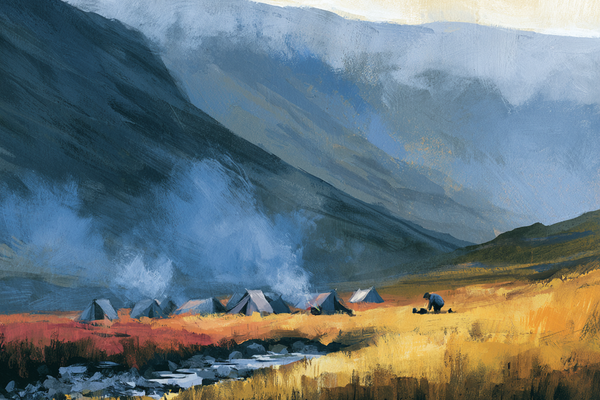
Most people also do it in summer, when the mountain huts are open. The huts feed you and water you, and you can travel light. Chris did it in autumn, when the huts were closing. So he carried a tarp, a sleeping bag, and food he'd bought from the supermarket in Geneva station before he started.
· · ·
The first day was meant to be the easy bit.
It wasn't. The end of a heat wave had settled over the northern Alps, and Chris climbed up out of Lake Geneva into baking sun on the steepest first climb he could remember. By the time the path levelled off he was wondering whether he'd made a mistake. Whether the whole thing was going to be like this. Whether he had enough water.
It took him about five days to settle into it. That seems to be his pattern. Four or five days, and the worries fall away. Whether you've got the right kit. Whether you'll find somewhere to camp. Whether you can do this for another month. After five days you're not worrying. You're just walking.
The average daily ascent on the GR5 is about 1200 metres. That's Ben Nevis from sea level. Every day. And then 1200 metres back down again. The passes are high but there are no actual summits, so it's just up and down and up and down, all the way to the Mediterranean.
· · ·
One day, late in the trip, the clouds started building and he could see a thunderstorm coming. He was up high. There was a place he could have camped, water and a flat spot, but he could see the weather coming in and he kept going. Down the loose stones of a long descent, all the way to the valley, where there was a road. He turned off the road into a wood and pitched the tarp there.

The thunderstorm hit that night. Cold, big wind, the lot. The next morning he looked back up at the path he'd come down and there was snow on it. First snow of the winter. He'd made the right decision.
He likes a tarp. He likes it because there's no door to zip shut. Even when he uses a tent, he leaves the doors open.
"I'm there for what's outside."
· · ·
The GR5 is really two walks.
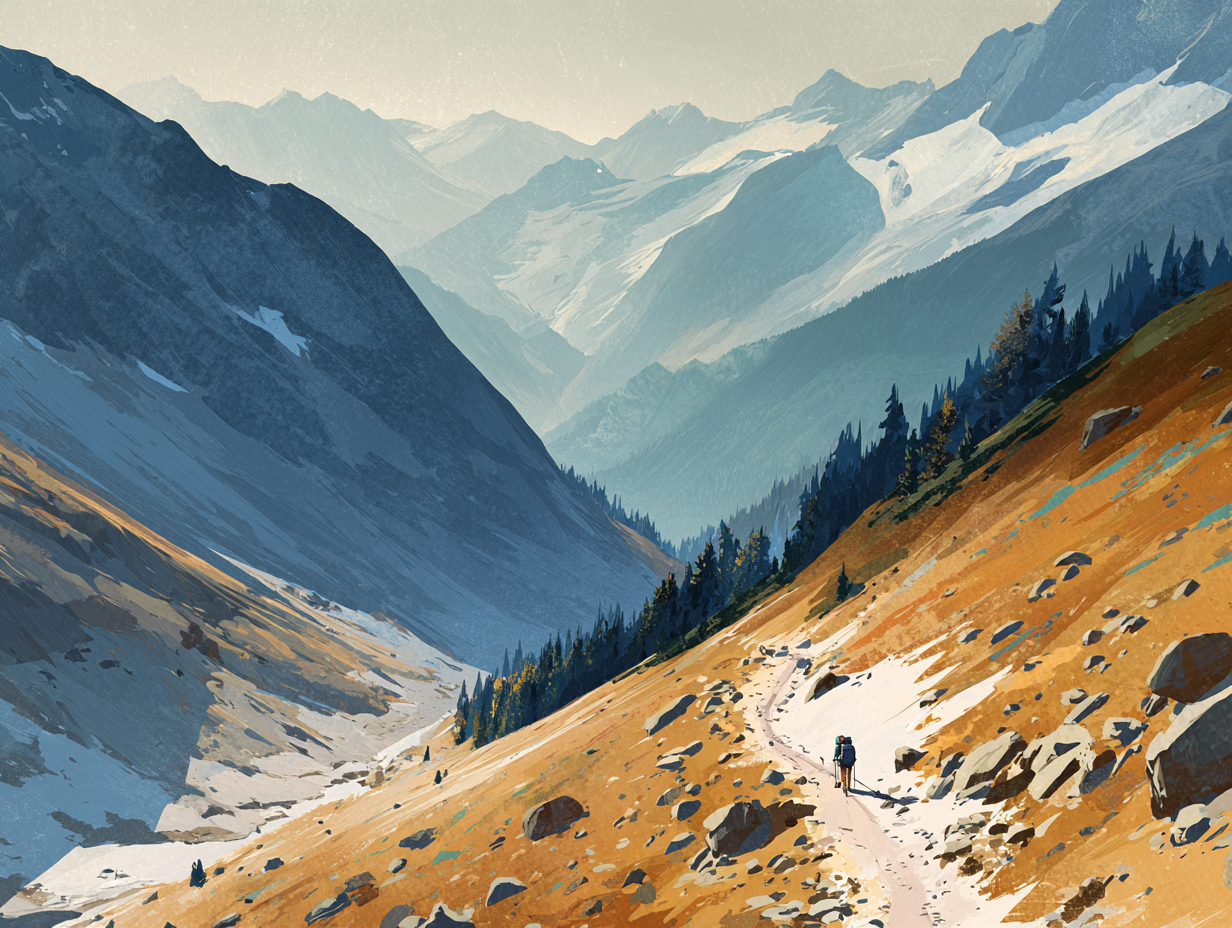
The northern half is the high Alps. Big snowy mountains. You walk past Mont Blanc. People with day packs. Mountaineers. The huts full of people who look at your big rucksack and ask what on earth you've got in it. Nobody backpacks through there, because nobody needs to.
The southern half is lower. The mountains are rocky rather than snowy. The forests get bigger and older. Conifers higher up, sweet chestnut lower down. The trail goes quiet. You see fewer people. Chris said the forests surprised him. He'd thought the GR5 was about the mountains, and it turned out to be just as much about the forests.
There are an awful lot of cows in the middle.
· · ·
In one of the bigger towns, Chris stopped for a night in a hotel to have a shower and resupply. By coincidence he'd picked an Italian-run place. Late in the season, the hotel was mostly empty, and the waiters seemed delighted to have a Brit staying.
So they did the whole thing. Operatic songs, sung at full voice, arms waving. They asked him several times whether garlic was alright with him. He said yes. They sang some more.
I think Chris was as much the entertainment as they were.
· · ·
Eight hundred kilometres later he came down out of the last of the hills into Nice. The trail markers carry on through the city. Red and white paint flashes on lampposts and walls, all the way to the promenade. He walked down to the sea, in his hill clothes, with the big pack still on.

People were sunbathing. People were eating ice creams. Even in October it's still hot enough on the Mediterranean to do that. Nobody looked at him.
"It's like you don't exist," he said.
He'd been on the trail for a month. The last person who'd looked properly at him was the shopkeeper who'd wandered back into his own shop, found a hiker at the counter, and made up a price.