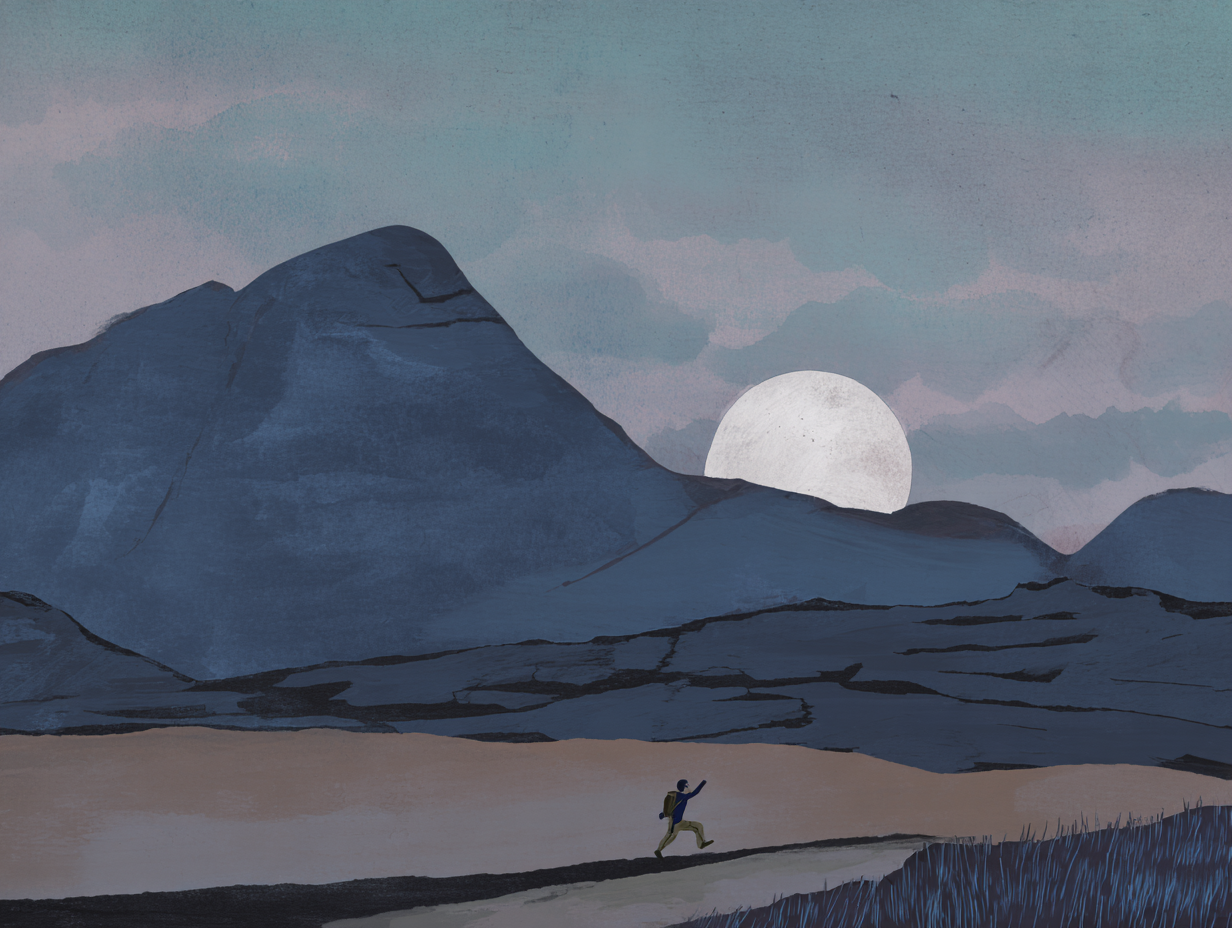
The moon was huge. Low to the horizon, the way it gets on certain nights in the Scottish Highlands — a thing you could almost reach out and touch. Wayne had his camera out, trying to get a shot. He couldn't quite frame it through the viewfinder, so he ran a few steps further up the ridge. Still not right. He ran a bit further. Then further. He kept running. He ran, as he tells me, "three, four, five miles" towards the moon, trying to get closer to it.
It's the moon. It's 238,000 miles away. It was not going to get any closer.
"I wasn't thinking logically," he says. He catches himself, and laughs, and the laugh is self-deprecating and entirely present — a man recognising across the table that the person he's describing was, for a moment, an idiot. This, more than anything he tells me in the hour that follows, is the thing I'll carry away from our conversation.

Wayne ran 5,000 miles around the British coast. He set off from Greenwich in September 2015 with a tent, a thousand pounds, and a rule he'd thought up on the Docklands Light Railway somewhere near Canary Wharf: keep the sea on your left and just run. He raised money in memory of his sister Carmel, who'd died of a rare heart condition. He was in his twenties, working in the music industry in London, a Gloucester boy feeling lost. Ten months later he got back to where he started.
He was supposed to set off a year earlier. I ask about that. There's a pause, and then, in the same deadpan tone he used for the moon: "It's literally my leaving drinks as well."
He'd had a bad year. His partner had met someone else. He'd gone back to Gloucester to save up. At the drinks where he was saying goodbye to everyone in London, he got drunk, took a shortcut home over a wall, and shattered his ankle. Ten pins, three plates. The whole run postponed by twelve months.
"Yeah," he says again, shrugging.
What surprises me, ten years on, is how small the first week was. He imagines it and his voice changes.
"I lost all my confidence. Every night just calling my mum. I turned into a mummies boy."
He's saying this looking slightly embarrassed by it — grown man, 28 miles a day average, admitting he phoned home from a churchyard porch in Kent every evening because he was scared. It's not the detail you expect from someone with a 5,000-mile run on their CV. It's the one you remember.

He slept in bus stations. He slept in church porches. Then, somewhere in Kent, he started knocking on strangers' doors and asking if he could pitch his tent in the garden. He had criteria for which door — not a terraced house, not a stately home, something with a bit of garden, a bit of seclusion. In Crackington Haven, in Cornwall, after weeks of wet weather and with his legs chafed to the point of tears, he knocked on a door. A couple opened it, looked at him like he might rob them, and told him to go away.
He was too desperate. He knocked again. They let him stay. They followed him online all the way back to the finish line.
"I can't, it's just their expressions really," he says, and trails off. It's the kind of moment that doesn't land as a dramatic detail — it lands as a small one, the way a real memory does.
The fire stations
A man called Patrick saved the run.
Retired fireman from Lytham St Annes, keen long-distance runner, Patrick invited Wayne to stay at his place and then, almost offhand, said: if you want, I can ring the next fire station. Then the one after. Then the one after.

Wayne thinks he may hold the unofficial record for nights slept in British fire stations — manned, retained, in Scotland where they're essentially corrugated iron sheds on the edge of the wild. It wasn't all comfortable. One night, soaking wet, he got into a drying cupboard at a retained station to warm up, fell asleep in the heat, and woke up with his eyelids crusted shut from dried-out sleep. He couldn't open them. Couldn't find the door. Kept putting his hand on a hot pipe in the dark. Was briefly, absolutely convinced he'd gone blind.
He tells me this with the same raised eyebrow he used for the moon.
We talk for more than an hour. He has never really told anyone this in full before, he says; his wife has heard it, obviously, but you know how it is — remember that time I ran around the British coast? — and she nods, and that's that. So he's been carrying this around, and some of it has settled into the kind of smooth stories you tell at parties, and some of it hasn't. The knocking-on-doors stories have. The drying cupboard hasn't. The moon hasn't.
I ask him what he misses most now, ten years in, a partner and a little daughter and a house outside Stroud.
"The unknown," he says. "That feeling of not knowing where you're going to be tonight. Whether you'll be safe. Whether you'll be warm."
He adds: "It's scary. But things always work out."
What stays with me, when I close the call, is a man in the Highlands in the dark, holding a camera up and chasing the moon up a ridge because for a moment it looked close enough to run at.
It wasn't. He ran anyway.