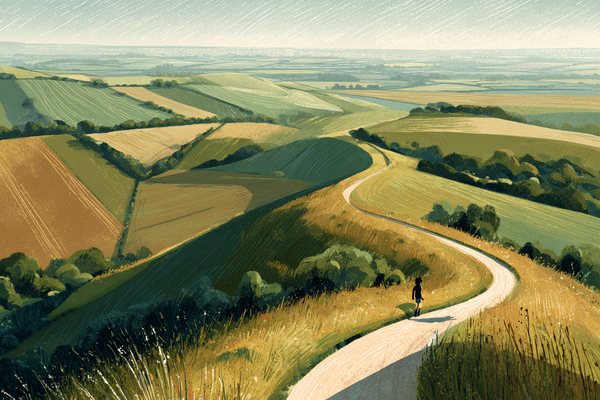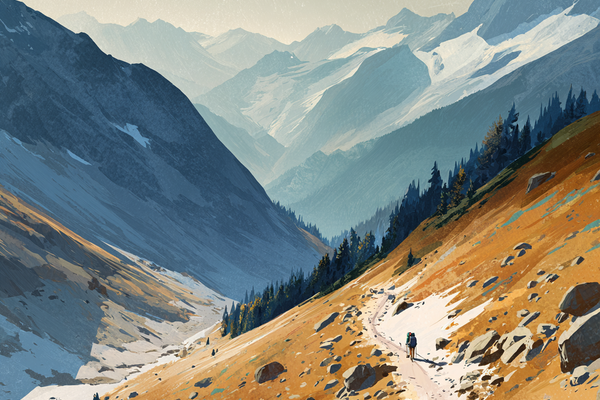
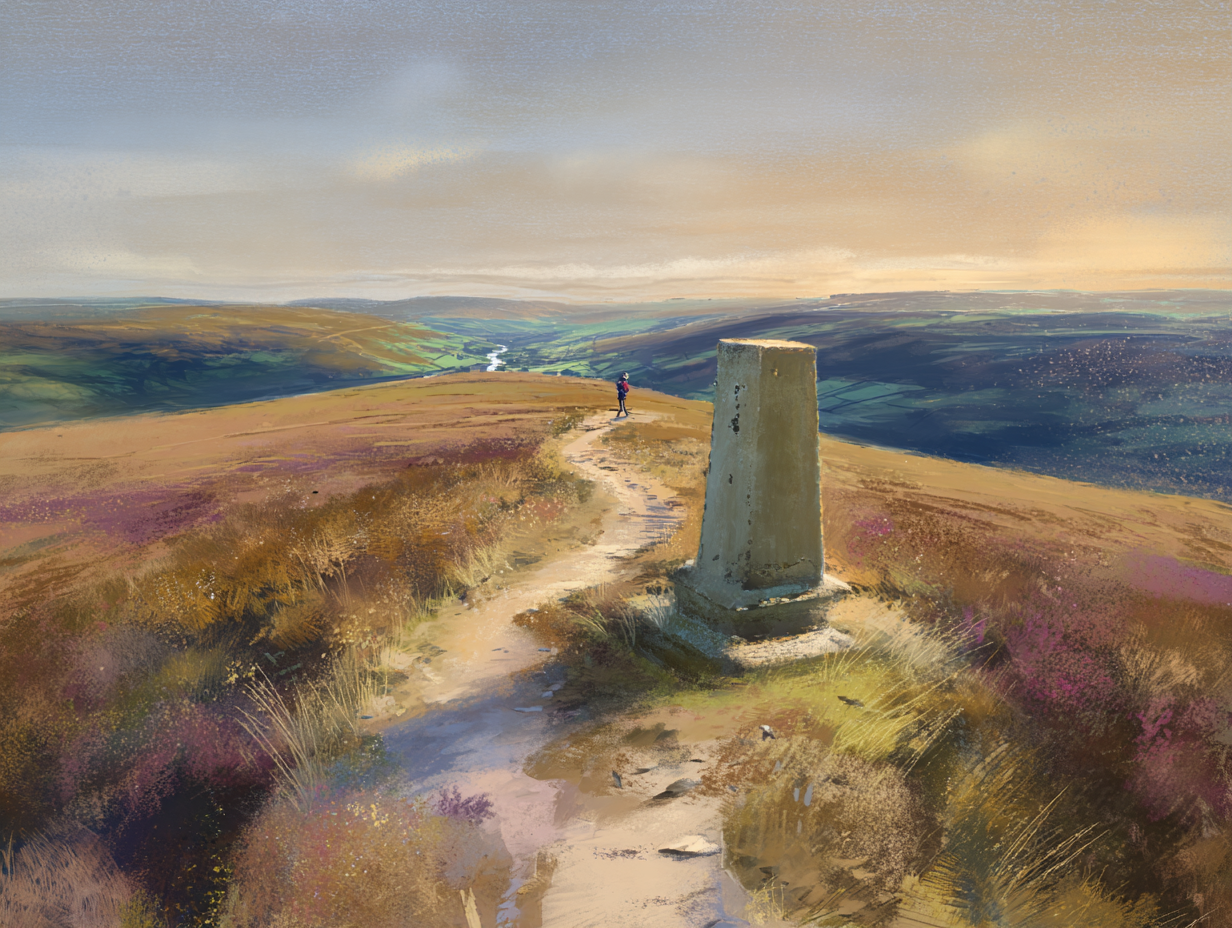
Martyn was on the Pennine Way, coming up to a trig point, when it happened. Twenty-five miles in the legs, the youth hostel visible in the valley below, the sun going down. He describes it carefully: the sense of joy that came from nowhere and overtook him. Not satisfaction exactly, but something closer to awe.
"It's almost as if you're hallucinating," he says. "But there are points in time when the environment, the weather, your own personal fitness, your state of mind — all of those things align. And you feel really joyful."
He's found it addictive. He’s sure there must chemicals involved. This addiction has led to him walking 19 of Britain's national trails - all them, until recently, when a new addition made it 20.
It didn't start as a list. Martyn Howe is clear about this. He walked the first trail because the national trails follow the national parks and the beautiful landscapes, and the signs are easy to follow — an acorn in England, a thistle in Scotland — and one enjoyable walk led, without any grand plan, to another. The list arrived later, as a way of tracking something that was already happening.

The acorn symbol became meaningful to him in a way he hadn't anticipated. Those small black waymarkers, appearing on posts, gateposts and fence rails, connected the trails to each other as something larger than any individual route. A sum greater than its parts.
When he arrived at Cromer at the end of the 19th trail — the last acorn he expected to ever follow — he found another one pointing east. The Norfolk Coast Path continued, and so did Martyn. He hasn’t ever really stopped walking.
What the Trail Does
Martyn tells me about the ten-day threshold. It’s something that’s come up in conversations like these before. It’s the point at which life on the trail stops being a departure from normal life and becomes normal life. The tent, the food, the people, the walking until dusk. Everything else — work, family, the quiet pressure of a domestic routine — fades away. Your ego, he says, ends up almost entirely unclothed.
This is a practical observation from Martyn, more than any great philosophical revelation. When you're stripped back to the basics, you become more open. Conversations happen more easily. People tell you things they wouldn't normally tell strangers. He has walked half a day with a retired Premier League striker who played for Middlesbrough, exchanging life stories on the coast path — the footballer fascinated by Martyn's journey, Martyn fascinated by his. Neither of them, he suggests, would have had that conversation in any other context.
And then there was the three-legged dog on the Pennine Way.

It’s clear Martyn is fond of this story, when he brings it up. A dog of complete, unqualified happiness, bouncing down the path, entirely unbothered by its own condition. The owner arrived shortly afterwards, equally cheerful. Martyn watched both of them and thought: if that dog is still enjoying life with three legs, I have no excuse.
It's the kind of moment that sounds small in the retelling and lands heavier than expected. He is not a writer who reaches for the grand statement when a specific detail will do the same work more quietly.
· · ·
On blisters, he has views. Years of them. He saw a physiotherapist eventually, after trying everything else — different socks, different boots, trail shoes, various taping regimes. The physiotherapist did gait analysis and found that Martyn's hips were stiff, which had caused his feet to turn outward slightly, which had changed the way his heel struck the ground, which had caused the blisters. He relaxed his hips and, like magic, the blisters diminished.
Getting to that point took years, he says. Don't man up and walk through it, Martyn advises. Stop. Tape it. Deal with it in the evening. If it becomes genuinely bad, stop walking.
On complacency, he is similarly frank. The more experience he has accumulated, the less carefully he sometimes prepares, and this has begun to cause minor problems — a wrong turn left unaddressed, something forgotten, an assumption that things will work out. They usually do but he knows that this is not necessarily something to be proud of.
What Technology Changed
Martyn started with a Sony Ericsson candy bar phone, a paper map, and a book of telephone numbers for accommodation. He would ring ahead from villages to ask if there was a bed for him. Now he uses digital maps, booking apps, trail webcams — all the infrastructure of modern trail planning — and finds it both useful and, in some respects, a loss.
The serendipity, he thinks, has been reduced. When you've seen the photographs of the bedroom before you arrive, when you know exactly what the view from the next ridge looks like, when a particular café in a particular village has been recommended by three people online before you've even laced your boots — something is pre-consumed. The expectation is set. And the trail, being an actual place rather than a curated one, doesn't always match it.
His solution, which he mentions in passing and which sounds completely right, is to switch his phone to aeroplane mode the moment he starts walking. It functions as a map and a camera only. Nothing else reaches him until he chooses to let it.

The digital map that Martyn is building — trailplanner.co.uk — attempts to do something different with all this data. Not focussing on navigation, which is well served already, but on relationships: between the trail and the geology beneath it, the bird reserves alongside it, the art created in response to it, the marine conservation zones, the coastal margins, the communities that depend on it. He has a background in geospatial IT with utility companies and has been quietly building this for years. It will probably take several more to complete.
He is also finishing a second book, The Coast is Our Compass, about walking the England Coast Path. It’s more philosophical than the first, he says, more immersed and more changed by what he saw. He hopes it will take readers somewhere they wouldn't otherwise get to — not the cliffs and beaches version of the coast, but the nuclear power stations next to nature reserves, the colliery tailings recovering into wildflower meadows, the flooding fenlands that were marshes once and will be again.
The writing itself came from a chance conversation on a trail. A woman told him: if you really want to retain something, write. He gathered his journals, found a stack of postcards he'd sent his wife from the Southwest Coast Path, and began. He found she was right. The experience of writing a walk is different from the experience of simply remembering it — more deliberate, more honest, more permanent.
If someone asked him which trail to start with, he'd say: don’t worry about that, just start. Pick something close to a rail line so you can bail out if you need to, for the first time. Don't overdo it. Distance, he says, is nothing to be concerned about. It’s only the first step which is difficult.
As for Martin himself, every subsequent morning on the trail he'll be up by five, out in the golden hour, listening for the birds before anyone else appears. That, he says, is the best time of day. That's when the Northern divers call.