He hooked his walking pole around the mallet and pulled. A polyphonic ring came out of the bell — one of those time and tide bells that hang in the intertidal zone and sound when the sea reaches them. The dog that had been barking fell immediately silent. The group of people who'd been standing there trying to work out what they were looking at made the connection: the churches swallowed by the sea, the bells that went with them, the warning that nobody heeded. A conversation started. As Martyn Howe watched it happen, he thought: it’s working.
He gets quietly emotional telling me this. Not in a way that needs managing, just in a way that tells you something about the kind of walker he is — one who has covered around 12,000 miles of coastline by foot and bicycle, seen all sorts of amazing things, yet still stops for a bell in Mablethorpe.
When Martyn arrived in Cromer having, he thought, finished all 19 National Trails (as the number stood then), he expected a sign marking the end. What he found instead was a sign marking a new beginning: another acorn fingerpost pointing east.
The Norfolk Coast Path continued, it turned out. And beyond that, in varying states of completion, was the England Coast Path — a project he knew about in the abstract but which suddenly, in that moment, became real and irresistible.
He walked it in five major sections over a couple of years. Sometimes he managed three weeks at a stretch, other times only five days. He took ferries where the route required it and he allowed himself a train from Berwick to Chester rather than walking the full Scottish border. The total came to around 2,400 miles. Just a fraction of the distance he’s travelled in total, though. He totted it up recently and arrived at something close to 12,000 miles between walking and cycling the coastline over twenty years.
That's roughly the distance from Heathrow to Manila, he says. Absurd, really, when you put it like that.
What the Coast Actually Looks Like
People picture cliffs, beaches, maybe a harbour. Martyn has spent enough time on the coastal edge to find those images a little lacking. Part of the picture, but certainly not the whole one. The England Coast Path also features colliery tailings on the Northumberland shore, where coal still seeps through the recovering ground. There’s a nuclear power station sitting in apparent peace beside a nature reserve. Ploughed fields stretching a mile and a half to a distant barn, with the tide audible but completely invisible beyond a seawall.
That last one is the Wash.
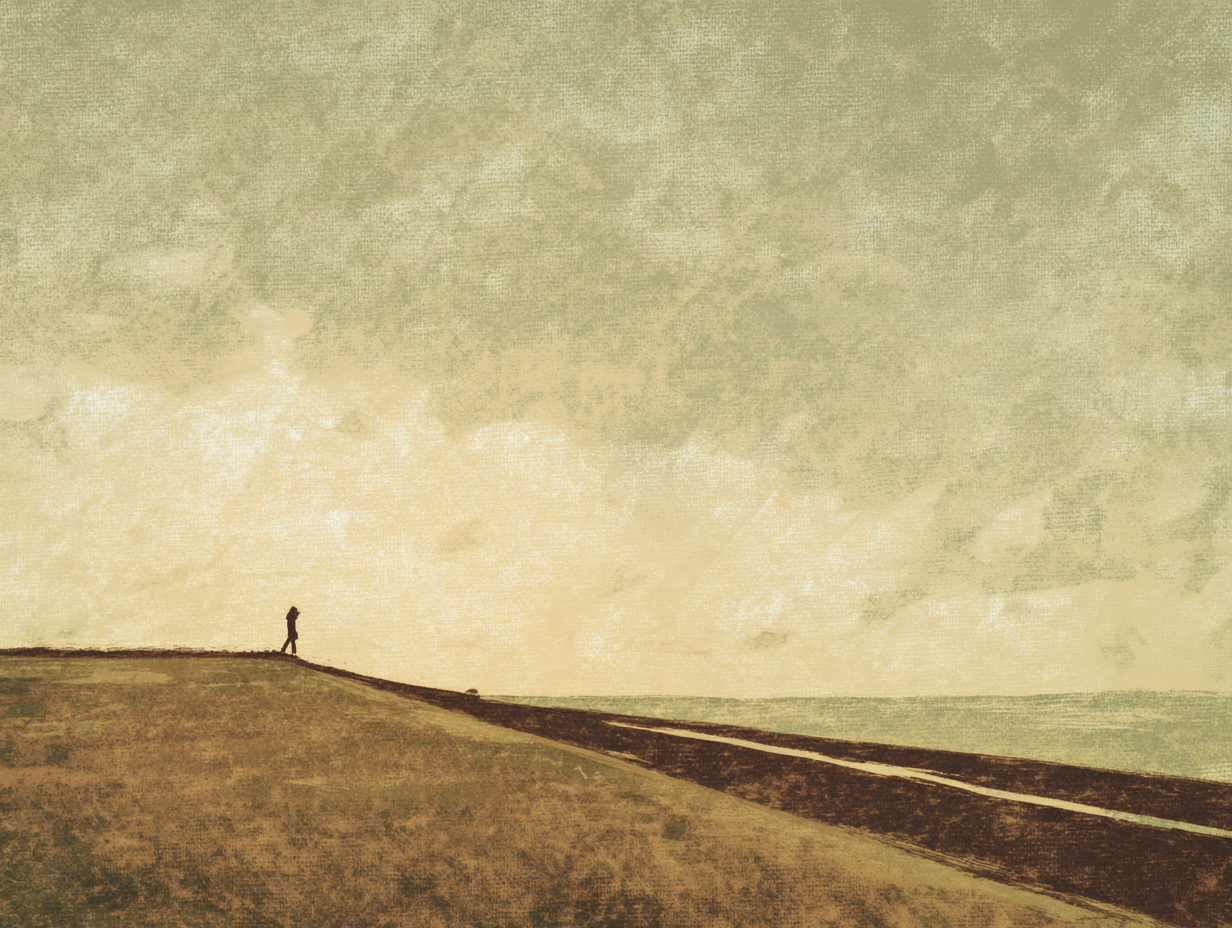
"You walk out on the seawall and you can't see anything," he says. "You can't see the shoreline because it's miles away. You can hear the tide coming in. And if you look inland, it's just ploughed fields. You can't see anybody. You can't see anything."
It was near the end of his journey. He thinks that might have had something to do with the impact it had. He'd walked most of the English coast by then, yet the Wash was still took him by surprise.

Martyn is good company when you get him talking about birds. A kestrel on the Dengie Peninsula in Essex followed him for about a mile — landing on posts ahead of him, taking off as he approached, landing again. He still doesn't know why. He was alone in a remote section and it went on for half an hour, and he's thought about it since. Eventually, he says, you spend enough days on the coast that peregrine falcons and buzzards become routine. Brent geese in winter — the noise they make gurgling in the mudflats — start to feel like friends. In a fourth or fifth onshore breeze that has him leaning into his poles, a tern flips a wingtip and shrugs it off entirely.
He notices these things and he notes them all down. The book that came out of the walk — his second, The Coast is Our Compass — is, he admits, almost a bird book, with a few other things included for good measure.
Walking as a Way of Seeing
The idea to write that book started years earlier, on a different trail, with a woman whose pace happened to match his for half a day. They fell into conversation the way you do on long walks, without preamble or social positioning. She said something that stayed with him: if you really want to retain an experience, don't just read about it. Write about it. Processing outwardly — whether it’s writing, painting or making — forces your mind to work through what it's absorbed.
He gathered his journals, found a stack of postcards he'd sent his wife from the Southwest Coast Path, wrote a couple of chapters, and found she was right. He can recall the detail of walks he did fifteen years ago in a way that a holiday in the south of Spain — lovely, unwritten, gone — simply doesn't stick.
The book has around thirty artists in it. Not a gallery section — they're woven into the walk itself, encountered on the path or sought out afterwards. Artists responding to coastal erosion on the east coast. Community murals in post-industrial northeast England. The time and tide bells. A textile artist called Debbie Lyddon, whose fabric work Martyn stumbled across in a church near Cromer — stitched, torn, dyed, buttonholed — and recognised immediately as the visual language of everything he'd been walking through. He found her sitting quietly in the corner and asked if he could use one of her images for his cover. Luckily, she said yes.
Graham was a man he met in Cumbria, on a trail that had been allowed to fall into disuse until the pandemic sent everyone outdoors and the local community started waymarking it themselves — little posts with white-painted tops, small wooden bridges over the wet bits, an old route reclaimed by people who needed somewhere to walk and decided not to wait for the council. Graham knew where the path went and where the nearest café was, and they sat and talked for longer than either of them had planned.
These interactions kept happening to Martyn. There was something about walking alongside someone — no eye contact, forward motion, no particular destination — that lowers some inhibitions. Conversations go beyond small talk, to somewhere unusual. At the end you shake hands and go your separate ways, walking away lighter than you arrived.
Going Lighter
Martyn travels with very little now. Twenty years of coastal walking have reduced his pack to the three things that matter — a good tent, a good sleeping bag, a good mat — and not much else. He wears trail shoes mostly, boots only when it's genuinely wet. He always carries walking poles and a phone permanently in aeroplane mode.
Every trip, he says, he comes home, turns the bag upside down, shakes everything onto the floor, and goes through it item by item. Didn't use that, didn't use that, could have not used that. Over twenty years, it gets lighter.
He also plans less than he used to. He knows that something will work out for the night's accommodation and that if it doesn't, he can always wild camp. The freedom that comes from not having every day mapped out in advance — he's convinced it makes him more attentive to the landscape he's walking through.
There is a saying he mentions, almost in passing: you should take a break, because if you don't, your body will take a break for you — and it won't necessarily be at a convenient time. It sounds like something he learned the hard way.

Near the end of our conversation, Martyn describes the walk as a pilgrimage. You are away from home. You are uncomfortable in small ways, regularly. You are alone, but not lonely. Your phone is off. Your mind, emptied of its usual noise, begins to process things — problems resolve, resolutions form, creativity surfaces. He says this happens reliably, every single time, not just occasionally. This is the real return on the miles, why these walks are worth it.
The coast, in the end, is not the destination, but the backdrop for the inward journey. Martyn has walked enough miles to know both happen at once.