Words: Rob Savin
The sheepdog came from nowhere.
They'd just dropped off the hill in bad weather, heading for a hut and a coffee. The trail skirted a pen of sheep — exactly where it was meant to go. There were signs up everywhere: keep your distance from the dogs. And then the dog arrived.
"He jumped up on my back," Elise Downing says. "He put a hole in my rucksack cover." Her dad Dave, sitting beside her as we speak, maintains the animal was playing. Elise is not interested in that interpretation. "He was a killer."
The shepherd appeared, called the dog off, and they went and had a Tarte aux Myrtilles to steady the nerves.
They were on Le Tour des Fiz, a hut-to-hut loop in the French Alps that most people have never heard of — despite it sitting just a short step from Chamonix.
· · ·
Dave found the route the way he finds most routes: scrolling the internet. This time, during a January of enforced stillness. He'd had his hip resurfaced in December — "resurfaced rather than replaced," he clarifies, with the emphasis of a man to whom the distinction matters — and by the new year he could manage about half a mile to the shops and back. Usually very active, this recovery period was a shock to the system for Dave. Elise remembers him walking around the house saying, “I’ve lost my purpose”.
So he found the Tour des Fiz. He wanted an adventure to look forward to that he was 99% sure he could complete, whatever shape he was in by September. He booked it. A few weeks later, Elise was visiting, noticed the EasyJet fares were cheap, and decided to tag along.

The Route Itself
What they had found was a loop around the Massif des Fiz — a big chunk of limestone, essentially - that takes you through a landscape that feels genuinely different from the more famous circuits nearby.
"We barely saw anybody some days," Elise says. "And then I went for a run on part of the Tour du Mont Blanc route the day after we finished, and I just couldn't believe how much more busy it was."
They did five days, averaging around 10km each. Their longest day was eight and a half miles. Dave had planned it this way deliberately. The Tourist Office PDF — a two-page laminate, schematically laid out a bit like the London Underground — gave them what they needed: hut locations, ascents, timings. A family itinerary, a sport itinerary, options in between. They did the family one.
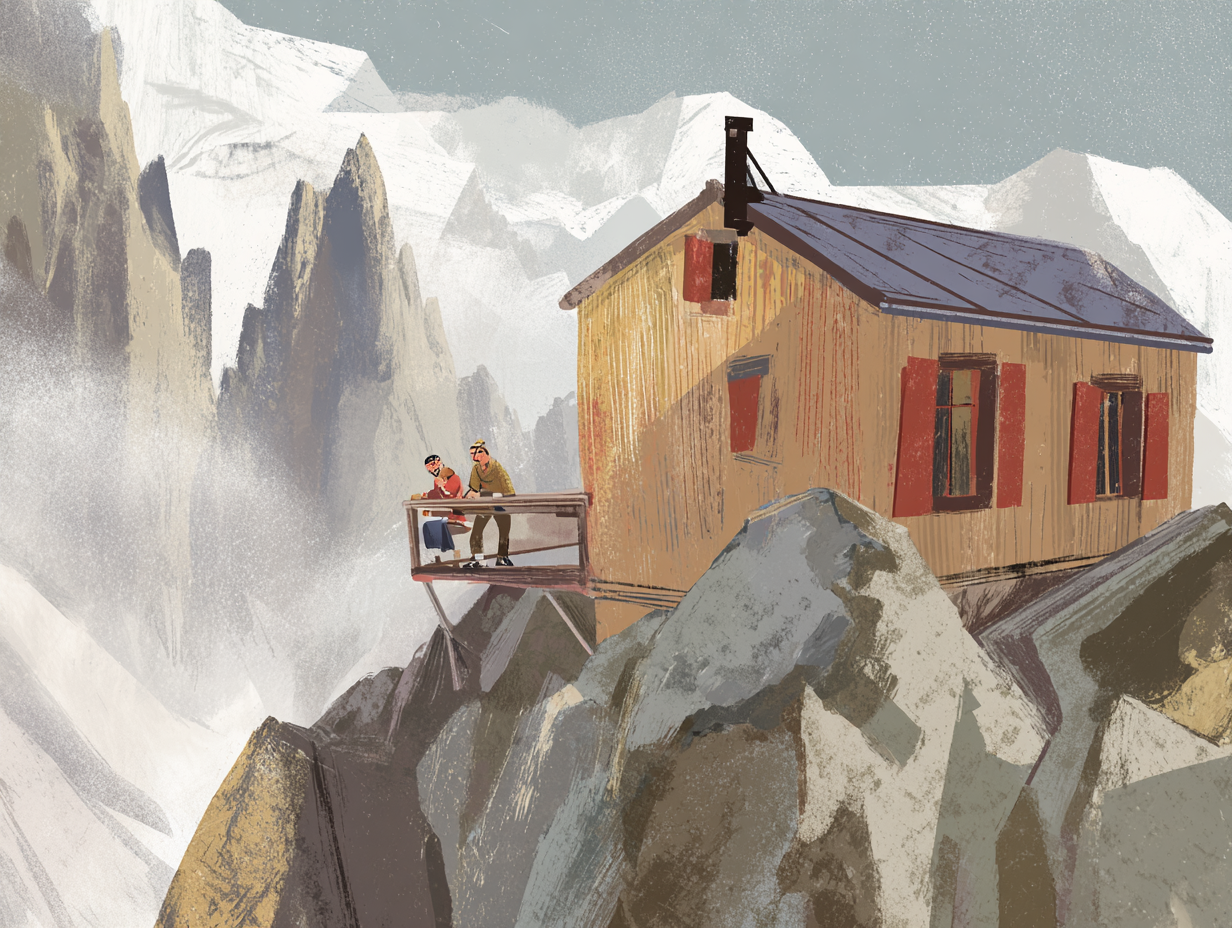
The huts were smaller than most of those big routes — at Refuge Des Fonts, Dave recalls the owner doubling as the only member of staff, cooking dinner and fielding questions. The hut appeared to have changed very little since for decades.
"I always think it's amazing," Elise says, "that you can be at 2,000 or 3,000 metres and you've got this hut and someone's cooking you a delicious dinner." She pauses. "There was a lot of cheese."
Fondue, tartiflette, a pasta dish which was as a regional speciality and which was, predictably, 99% cheese, cheese omelettes, cheese sandwiches... "By the end," she says, "I was like, I'm going to get gout."
The weather came and went. On the cloudy days, they were close enough to the limestone that there was still something to look at — the geology of which Dave could half-explain and Elise could half-understand. There were waterfalls on the long descent from one hut to the valley below, then marmots and ibex and one Alpine cow encounter that Elise, who is irrationally frightened of cows in the UK, handled better than expected. The bells, apparently, help.
"Even when the weather was rubbish and you couldn't see everything, there was interesting stuff close up. It wasn't like being stuck in a cloud with nothing."
· · ·
An Argument for Dawdling
Something I notice, listening to them talk about this trip, is how often they come back to the pace of it. Not apologetically — more as if they're still slightly surprised by how much they enjoyed it.
Elise and Dave both run ultras. They’re often trying to fit too much trail into not enough annual leave. They’re normally attempting to cram two guidebook stages into one day, already feeling behind schedule before breakfast most days, unable to afford the luxury of long breaks. On the Tour des Fiz, they stopped for a leisurely lunch at a hut every single day. They had so much reading time, they ran out of books. They spent afternoons sunbathing after early arrivals at huts.
"It didn't feel like it wasn't enough," she says. "We still felt like we'd done something. We just also had time to look at things."
Dave is more direct about it. After the hip operation, after the months of cautious walking and internet research, after the thing they'd had to bail on two years earlier because the pain was too much on the morning they were supposed to start — he was, he says, just happy to be there. Two and a half miles on day one, Mont Blanc in front of them, beer in hand.
"I was very happy to sit there," he says, and doesn't embellish it further.
I ask them both what they packed. This turns into a longer conversation than expected, in the way that packing conversations always do once someone experienced starts talking. Thirty-litre bags. Running kit — light, packs small, dries fast. A sacred set of clean, dry clothes kept for the evenings, never touched during the day regardless of temptation. Sliders worn with socks (you won't look cool; your feet will be dry; you will be happy). A sleeping bag liner, because the huts don't change sheets as often as guests might like. Earplugs. Eye mask.
And lip balm. Lots of lip balm.
Dave cannot be without a Chapstick. This is established early and emphatically. When he's excavating everything from his bag for the third time on a given morning — because he can't quite remember whether he put everything back in the second time — the Chapstick is what he's looking for.
"You've never seen anything like it," Elise says.
· · ·
The standout moment, for both of them, came at the end. The final day, clear weather after several days of cloud, the climb up to the Col de Brévent and then the descent back towards the Chamonix valley. The big mountains that had occasionally appeared between clouds, that they'd glimpsed and half-seen, were suddenly right there. All of them. Unambiguous.
"We'd had a few days of not amazing weather," Elise says, "and then it was beautiful and sunny again, and all the big, big hills appeared in front of you."
Dave had another favourite moment too: the descent past the waterfalls, on a wet day earlier in the week, waterproofs on. "Absolutely fantastic," he says, and sounds like he means it.
As for the worst moment, they both agree that it was the sheepdog. Elise’s torn backpack would agree.