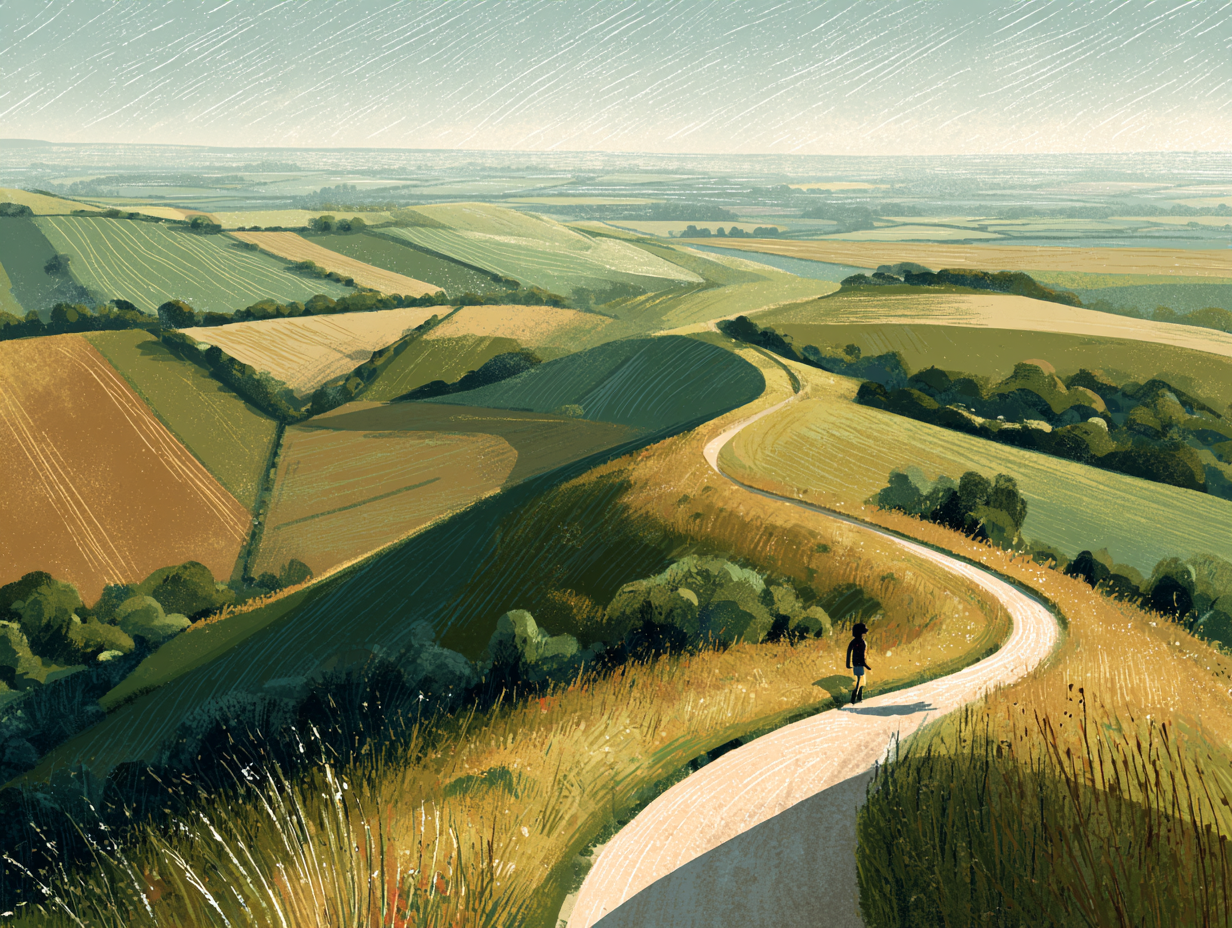
Somewhere on day two, on a long stretch of bridleway in the Wessex Downs, Elise Downing and her friend Sophie caught up with the rest of the group. They were earlier than they had expected to be.
The other two, Ange and Oscar, had left the B&B before breakfast had started, so that Elise and Sophie could have a lie-in, a full English and what was meant to be a sizeable head start. The maths didn't quite work. By lunchtime they had overtaken.
"We were really happy to see them. We thought they'd be excited to see us. We got such a frosty reception."
· · ·
Elise is a writer and a runner. In 2015 she ran five thousand miles around the coast of Britain, which is the kind of thing people lead with when they introduce her. She doesn't lead with it. On the Ridgeway, in 2020, in one of the windows between lockdowns, she was on holiday with three friends.
The trip had a format. They had tried it once before. On the West Highland Way in 2018, Elise and Sophie had run the daily mileage and Ange and Oscar had walked it. Same start times. Same distances. Day one had been forty-two miles. On day two, Ange and Oscar's blisters ended the experiment.
"We're not learning anything from the last time," Elise said, when she described day one of the Ridgeway. They had decided to do exactly the same thing on a different trail. Twenty-nine miles on day one. Thirty-three on day two. Ange and Oscar had not waterproofed the inside of their backpacks, again, and when they reached the pub, soaked, there was not a single dry thing to put on.
When I asked Elise what she'd thought, sitting at that pub table, she didn't quite answer. She said it was the kind of trip they still talk about. She said it was funny.
· · ·
The Ridgeway runs 87 miles from a hill in the Chilterns called Ivinghoe Beacon to the stone circle at Avebury, across the chalk uplands of the Wessex Downs. It is often described as Britain's oldest road. It has been a route for several thousand years. Drovers moved cattle along it. Medieval traders moved goods along it. You can walk it now without needing much more than a packed lunch and a phone signal.
It is not a wild trail. The terrain rolls. The waymarking is good. The villages are close enough that you can refill a water bottle and buy a sandwich without much effort. By most measures it would make an excellent first long-distance walk.
It does not necessarily make an excellent first ultra.

After the overtake, with everyone now arranged in the order the format had expected hours ago, Elise and Sophie pressed on. They had to kill a couple of hours in a café up the road. Sophie's dad was picking everyone up that evening, at the finish point Ange and Oscar were aiming for. There was nothing to be gained by arriving early.
The shoulder bruising, Elise told me, is the thing people don't talk about. Even without camping kit, the pack digs in. You stop for a sit-down. You put it back on. The first mile after that, she said, feels like running on two sticks of rock. Then you walk a bit. You settle into it. You carry on.
Through the harder stretches, she said, there was a small unspoken consolation. It could be worse. It could be Ange and Oscar.
· · ·
The third day was shorter. Twenty miles into Avebury, finishing at the stone circle by lunchtime. Elise and Sophie ran it together. Ange and Oscar, by mutual agreement after the previous evening's debrief, were waiting at the end.

The stone circle is a good finish. Most national trails end at a wooden post in a car park, or at a Wetherspoons. Avebury ends with something older than the road itself.
On the way in, with the trail running between fields of low chalk grassland, Elise was thinking about the people who had been on this same line for several thousand years, walking it not for fun or for fitness but to get somewhere.
"Now here I am in my Lycra and breathable kit," she said. She liked the contrast.

Ange has since been back to the West Highland Way. She did it the conventional way. She wanted, in her words, to settle the score.