His wife could hear them first. Scuttling. Rustling through the snack bars they'd left by their sleeping bags. Andy Dickson was in a dormitory at Tengboche Monastery, somewhere above 14,000 feet, wearing every layer he'd brought and a new double-thickness hat he'd bought from a vendor on the path that afternoon. He was not particularly concerned about the mice. They lived here, he reasoned. He and Janice and their son Graham were just passing through.
Janice did not share this view. Eventually she unzipped her sleeping bag to deal with it. Andy did not help. It was, he now admits with some pleasure, not his finest hour.
The next morning was the one he'd been waiting for most of his adult life.
Andy has been drawn to mountains since his teenage years. His wife — girlfriend then, married now for forty years — felt it too. Scotland first, then skiing, then the slow accumulation of a life in which the mountains were always somewhere in the background of the plan, fitting around work and family and three sons and the general machinery of a busy middle-class existence. Everest was not something that happened quickly. It was a goal Andy moved towards for a while.
He'd been to Nepal once before, with Janice, to the Annapurna region — not the full circuit, just the lower mountains, but enough to fall entirely in love with the place. The prayer flags, the bells audible from miles away, the people. He uses the word phenomenal a lot when he talks about Nepal, and it always sounds genuine.
This time they brought Graham, twenty-two, just out of university. Graham's first impression of the country was the immigration queue at Kathmandu airport — pencil and paper, four or five hours, jet-lagged and bewildered after three flights via India. He turned to his parents at some point in the queue and said: you've done this before, and you came back?
They had. They came back again.
Slowly, Slowly
The trek follows a metered rhythm enforced partly by the altitude and partly by their guide, Xanakir, who is experienced enough to know what happens when people go too fast. Day one: three hours of hiking. Day two: five hours, with stops for tea. Caffeine avoided at altitude — it dehydrates, compounds the headache that's coming regardless. You arrive at each teahouse in the afternoon and then, largely, you sit. There is nothing much to do except look at the mountains - but then that is the entire point of being there.

Andy is a vegetarian and ate dal bhat — rice, lentils, potato curry — at almost every meal, as the non-veggies mostly end up doing too. The Tibetan bread is something else. He brings it up several times and can't quite explain what makes it extraordinary: thick, aerated, moorish, with some magic ingredient he was never able to identify. He has not found anything like it since.
The teahouses themselves are plywood buildings that look, from the outside, like real houses — small windows either side of a front door, corrugated iron roofs, a dining room, a kitchen, bedrooms barely wide enough to turn around in. The walls don't insulate. There is no heating except one communal fire and, at the higher stops, hot water bottles distributed at bedtime like a very remote version of a guest house. Andy describes them affectionately as “adequate”.

Janice showed symptoms of altitude sickness on the acclimatisation day — unexpected, because they'd been at altitude before without trouble. The guide fetched a doctor. A young Nepali physician arrived at the teahouse, assessed her, gave her medication, and told them the rest of the trip was in jeopardy but manageable if they watched her carefully. In the medical facility the next morning, while Janice was being checked over, a helicopter came and took another trekker away. Fit looking, Andy says. Younger than them.
She recovered and they continued. But that waiting room recalibrated something — reminded all three of them that the altitude in the Himalayas sits differently to altitude elsewhere. The mass of the range changes the equation. Andy had been to Kilimanjaro at 20,000 feet and been fine. Janice had been sick here at 11,000. The mountain does what it chooses.
What He'd Asked For
He had mentioned, earlier in the trip, to Xanakir, two things he hoped for: to see Everest, and to stand on snow in the Himalayas. He hadn't done either yet.
Luckily for the latter, it snowed that night at Tengboche.
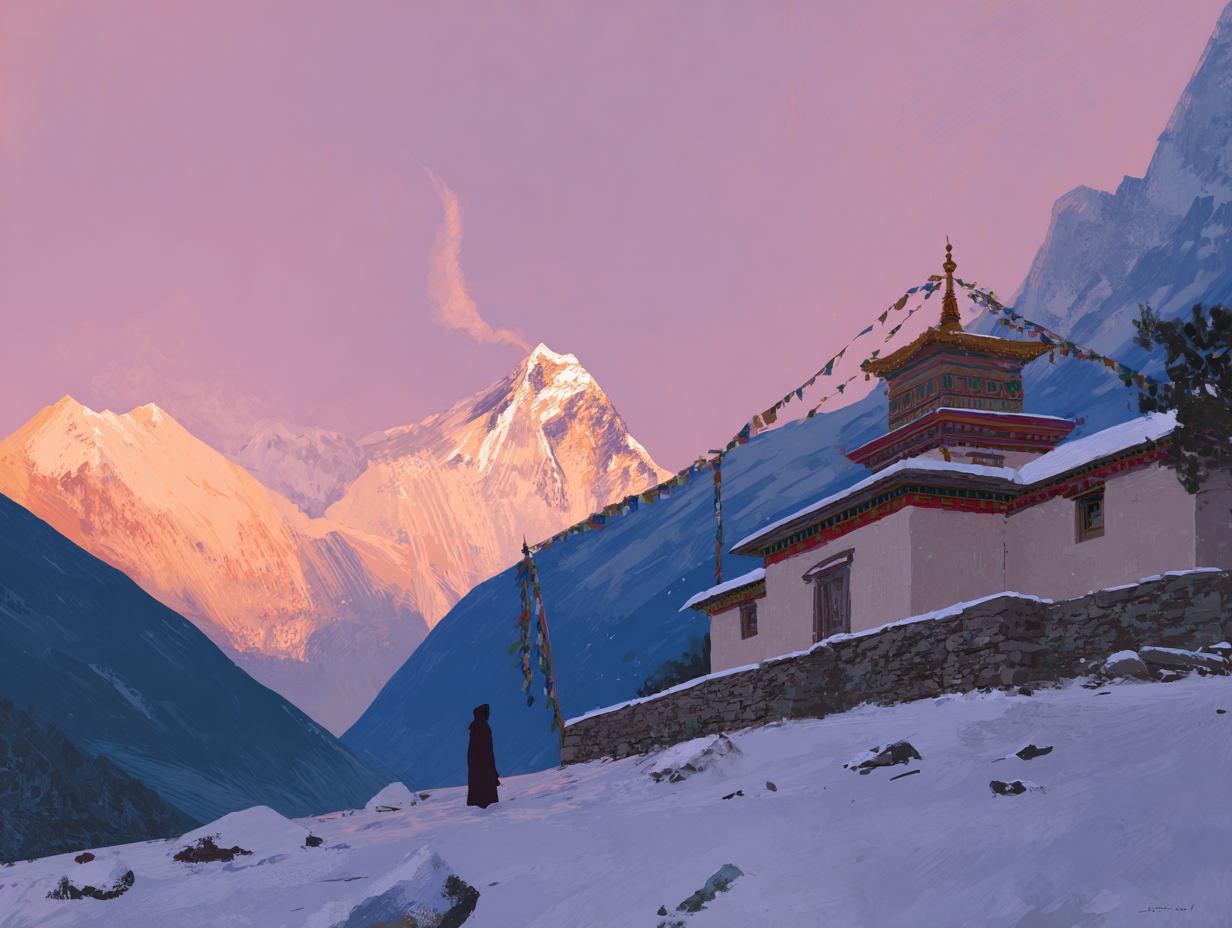
He got up before sunrise and stepped out onto fresh snow — not deep, but enough for footprints, enough to make the whole monastery and the valley below it completely white. He stood there in his tea cosy hat and watched. Then sun came up behind the peaks and revealed the summit of Everest — just the top, with the wind trail blowing off it, the signature flag of cloud that means the jet stream is crossing the summit. Tengboche Monastery in the foreground, something out of Indiana Jones, as he puts it. Everest on the horizon. Snow underfoot.

He was, he says, very happy.
After forty years of wanting something, very happy is enough.
The descent was its own pleasure — the snow line receding as they dropped, sun hitting the leaves and running off in small drips, the vegetation coming back green and then greener, the air thickening, the weight lifting from each step. They had their guide up early each day to beat the worst of the bottlenecks on the path. The trail itself is ancient in its feeling: large paving stones giving way to dust, trains of yaks carrying provisions to the villages above, suspension bridges over gorges that require waiting your turn when a yak train is crossing. You do not hurry a yak.
At the final teahouse on the way down, the woman running it took a particular shine to Graham. She was motherly towards him. When they left, she gave each of them a small silk scarf. Andy still has his.
Just Do It Now
I ask him what he'd say to someone who has been thinking about Nepal for years and keeps not going. He doesn't pause.
Go now. Don't wait until you have more time or more money, because you won't. Don't wait until the children are older or the job is less demanding or the moment feels more right. He did this in the middle of a busy life — three sons, a full career — and it was the right decision. Nepal is changing, he says. Less developed places becoming more developed. The thing you're dreaming of may not be the same thing when you finally arrive.
He’ll go again, as soon as possible.