Words: Rob Savin
She woke up to scratching on the tent.
Deep sleep, wild camp, somewhere on the Welsh coast. Sophie McCarthy's brain cycled slowly through its options. I'm not in America, she thought, so it can't be a bear. It can't be a bear, so it can't be that bad. She kicked at where the sound was coming from. Something large pushed back. Her brain, still not quite functioning, returned to bears. If it was a bear, you'd be noisy. Then she said, at entirely normal conversational volume: go away.
It left. She lay awake for an hour waiting for it to come back with reinforcements. Luckily, it didn’t. Later she realised it had just been a badger.
"I just think it's the funniest thing," she says. "That the two words I could get out of my mouth in that moment were just: go away."
· · ·
Sophie walked the Pembrokeshire Coast Path solo over fifteen days in June, carrying a tent, sleeping mats — two of them, because she doesn't entirely trust the inflatable one — a pocket rocket stove, porridge in pre-bagged portions for every morning and, at one point, four or five days' worth of food alongside three litres of water. She never weighed the pack. She's fairly sure this was the correct decision.
"I would rather have a slightly heavier pack and go slower," she says, "than be a super lightweight camper where I don't have the things that allow me to be comfortable. I accept that about myself."
She started in Amroth and finished in Cardigan, south to north. Sophie has a preference over direction choice that she’s worked out over several routes now, on the Cumbria Way and the Coast to Coast as well as in Pembrokeshire. She always likes to be walking in the direction of home. The whole path then, she says, feels like walking home.
· · ·
What She Was Carrying
The first morning was hazy and warm. Family members dropped her at the start — they're walkers themselves and bought her the guidebook for Christmas — and she realised immediately that she'd left her poles in the car. A brief panic ensued. Luckily, they had a spare pair in the boot to lend her.
"Lots of anticipation, lots of excitement, and also a sort of anti-climax," she says, "because you're like, oh, I'm starting, and then you're like, cool, I just start walking."
After all that planning, she just kept the sea on her left and got on with it.
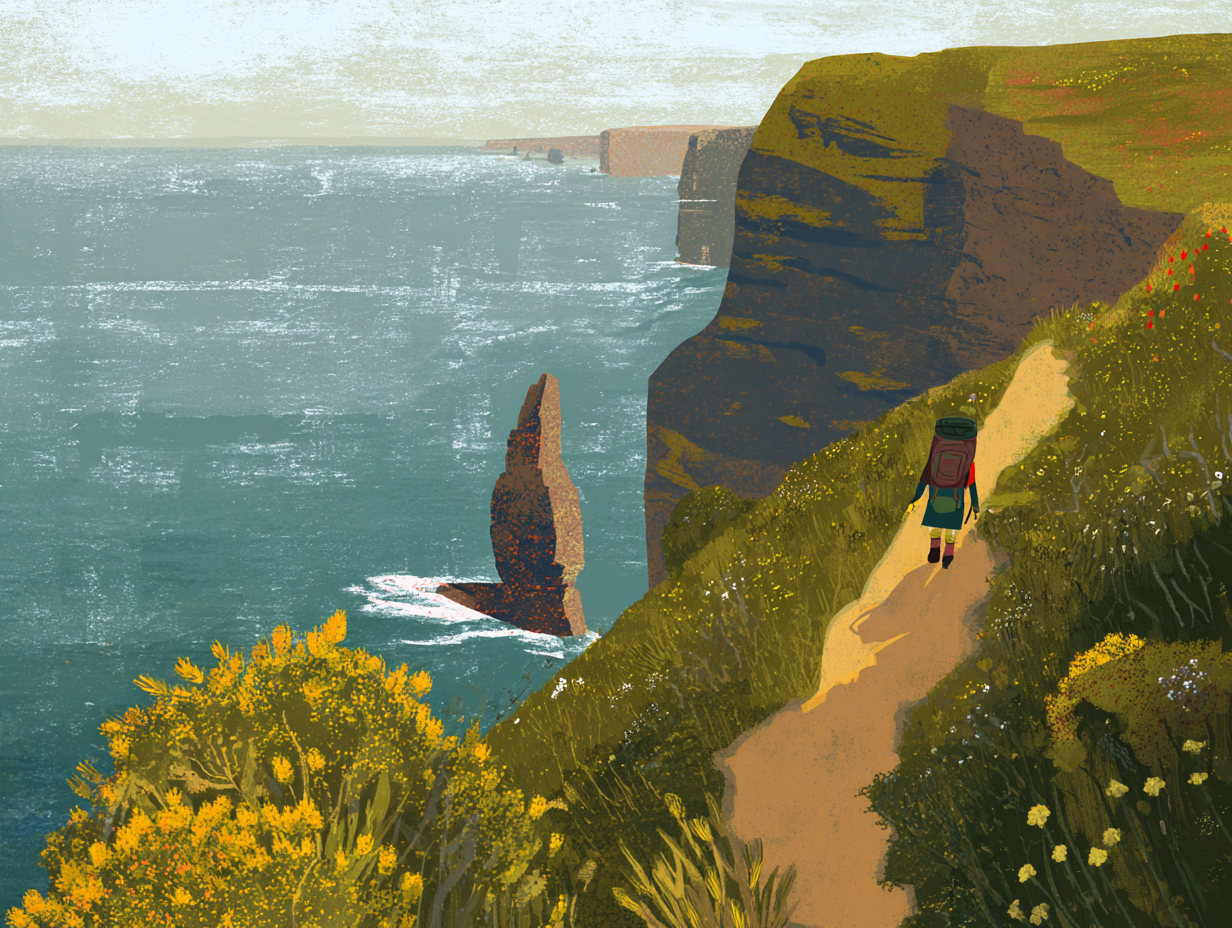
The Pembrokeshire Coast Path is 186 miles of cliff edge, harbour, beach, headland, and pub. It is never navigationally difficult — there is always a path, and you can usually see where it goes — but it is relentlessly up and down in a way the total ascent figure makes plain: the cumulative climb is more than the height of Everest. In June, it is also in full summer growth, which means stinging nettles coming at you from all angles, and the additional challenge, if you're carrying a large rucksack, of squeezing through hedgerows that are barely wide enough for someone without one.
She camped most nights. The campsite in Fishguard with a much-needed restaurant attached stays with her. And the campsite where she found even more needed laundry facilities, near to a shop where she'd just restocked with fresh tortellini (fine to carry for half an hour, but not for two days).
"I think it's funny what sticks in your mind," she says. "It often becomes these nonsensical things. Where were you? What were you doing? And it's like: I had pasta."
"I think I'd rather have a slightly heavier pack and go slower and it be a bit harder, than be a super lightweight camper where I don't have the things that allow me to be comfortable."
On her penultimate day of walking, the rain set in for the first time and she got absolutely soaked. She briefly considered camping and found a last-minute hotel instead. No regrets.

The Thing About Pubs
There is a section of our conversation where Sophie talks about pubs the way other people talk about mountain summits. A pirate-themed place on the first night with a curry that wasn't what she expected and better for it. A pub on the harbour in a town she'd walked down to from the campsite — fish and chips, a pint, sunshine. She says she can picture both places clearly.
"That's one of the major differences between doing this kind of thing in the States and doing it here. You're much more likely to go through a town or a village and there'll be a pub."
Those small comforts make a huge difference on these types of adventures. When I walked the Pembrokeshire Coast Path, my wife and I had banned any mention of our feet — because as soon as we mentioned them, they hurt ten times more — and we were heading somewhere called Trefin. A woman came out onto the path and corrected our route, leading us to the campsite. In my memory she is an angel. Trails do this: they sharpen the small things until they're impossible to forget.
Sophie remembers meeting three men walking in the opposite direction — old friends, she thinks from school or university. They’d started the South West Coast Path together and done a week of it every year until it was finished, then immediately needed somewhere new to go. They were on their first week of the Pembrokeshire Coast Path.
"I just thought that was such a lovely thing," she says. "Such a lovely way to prioritise friendships."
· · ·
Hard Things
Sophie came to hiking sideways. She grew up in Somerset, surfing and camping, then spent years thinking she was a city person. A year in Japan changed this perception of herself. She bought boots, joined some Americans she knew for a three-day temple pilgrimage — the Kumano Kodo — mostly just to be part of what they were doing. Then she spent time in the States working at camps for children, where backpacking was part of what they did with the kids, and she found herself leading groups into areas she didn't yet know, which terrified her.
"I also made some really wonderful friends," she says, "who facilitated incredible trips. When I wasn't very experienced, that allowed me to really just appreciate the amazing stuff that can come from this."
She retrained as a speech and language therapist back in England, and started looking at what the long trails here had to offer. It turns out there are quite a lot of them.
I ask about comfort zones — the badger, the rain, the fall she had somewhere along the path where she went feet-first in a way she describes as “banana-shaped”, bruising her finger purple in the process but managing to see the funny side.
She mentions, carefully, that she's struggled with her mental health at times, and how her time on the trails helps with that.
"One of the reasons I like doing them," she says, "is because they remind me that I'm capable of doing hard things."
She tells me about climbing the Grand Teton in Wyoming, how hard it was, and the thought that arrived somewhere near the top: you got over depression and that took months. This is only going to take hours.
There's a version of that logic available to anyone with a heavy bag and a long day ahead. You don't need Wyoming. Any trail will do it - including the Pembrokeshire Coast Path.
On the last day, the path drops down to the Teifi estuary and the town of Cardigan. Before it gets there, in the final northern section, the landscape shifts — more grass on the cliff tops, more ruggedness, the sea louder and closer. Sophie says this is the stretch she'd point someone towards if they only had a week.
She's already planning her next trail.