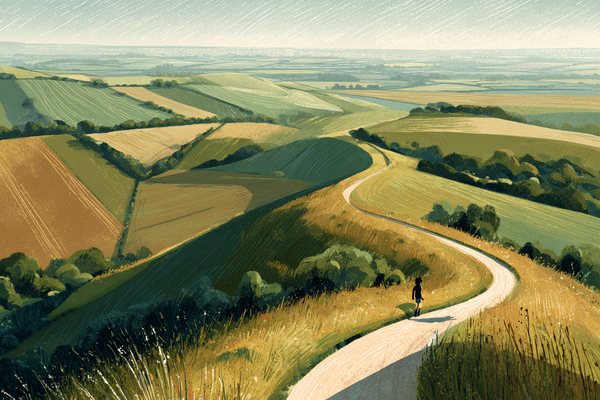
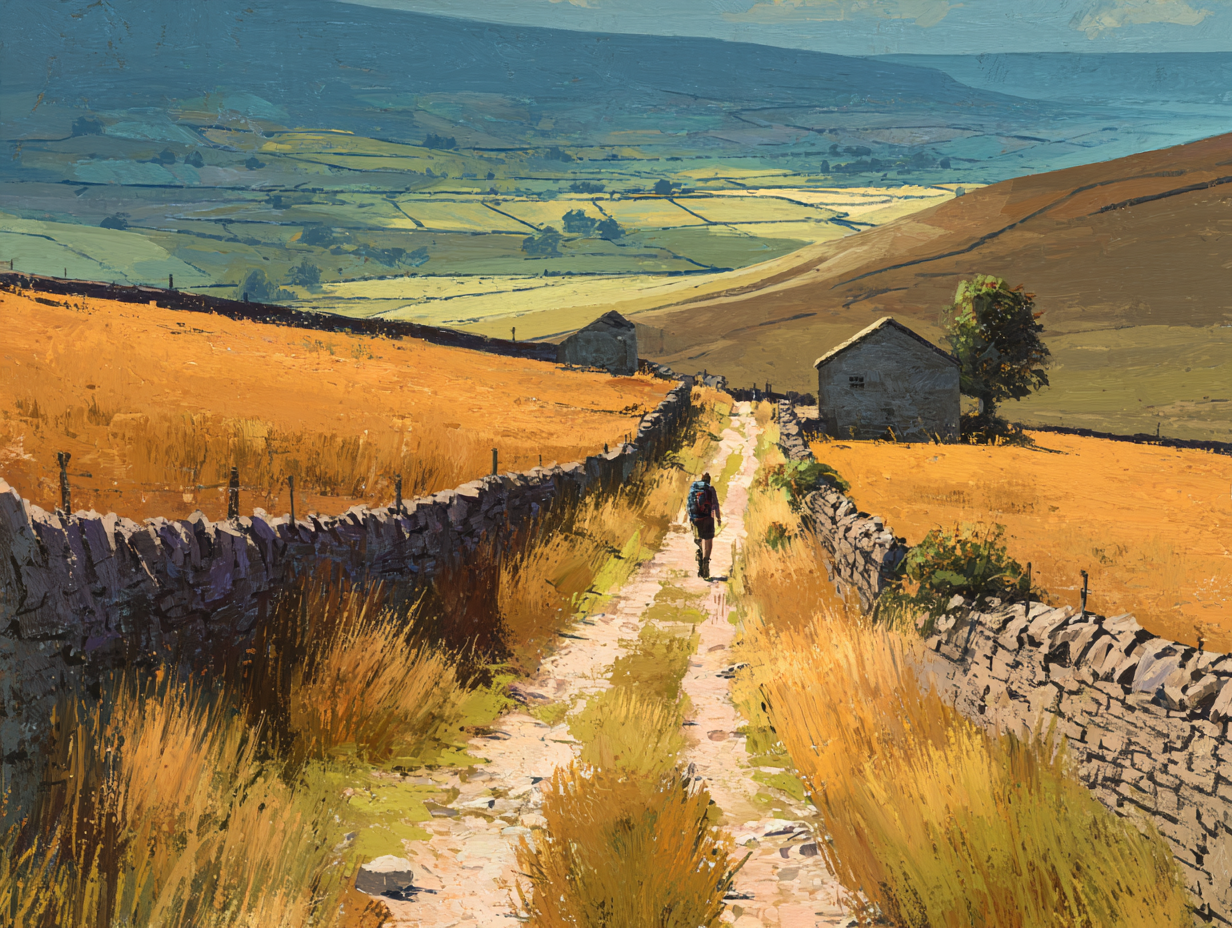
On day three, Jessica Mather was excited to see a motorway. She couldn't really say why. Somewhere between Cowgill and Sedbergh, she'd convinced herself the M6 bridge was going to be a moment. A landmark. Something to mark the slow drift west out of the Yorkshire Dales and into the Lake District.
"Then I got to it," she says, "and I was like, oh God, this is awful."
She laughs about it now, recounting the walk to me. The bridge had been doing a lot of work in her head, and the actual bridge — six lanes of traffic at speed, fenced off and grey — was just a bridge. Worse than that, it was a bridge that had borrowed a day's worth of anticipation and given nothing back.

Jessica is a mountain leader who lives on the edge of the Lake District. She came to the outdoors late — her early twenties, after a childhood with horses rather than hiking. The Dales Way, last July, was something close to a homecoming. Eighty miles, give or take a few side quests, from Ilkley to Bowness-on-Windermere. Through two of England's best-loved national parks, alongside seven rivers — the Wharfe, Dee, Rothay, Lune, Mint, Sprint and Kent — and through the kind of farmland and quiet villages that don't make it onto postcards.
Most people walk it in five to seven days. Jessica did it in four. Three of those days were over twenty miles. She camped at three unusual places: a conventional site at Kettlewell on the first night, a riverside field at Cowgill called Ewegales (booked, old-school, by phone), and a beautifully kept back garden somewhere outside Grayrigg. Two of the three required an actual conversation with a human to book. The Cowgill site also had, she'd later report, the worst midges she had encountered anywhere — and she has been to Scotland.

The day before the M6, on the long stretch from Kettlewell to Cowgill, her feet swelled up. Not a blister thing. Not a wrong-shoes thing. Just feet, on day two, refusing to behave. There is a particular kind of demoralisation that comes from walking through one of the most beautiful sections of a trail with feet that hurt, and it ground at her.
"Luckily we're on seven rivers," she says, "so I could keep dipping my feet."
She means it as a practical observation, but it lands as something else: the trail providing an unintended remedy. They stopped frequently. She pressed on. They saw nobody for hours other than farmers — including a man in his late eighties, fishing, who they ended up talking to for some time. The Dales Way is described in guidebooks as accessible, well-trodden, easy to plan. On day two, between the last camp and the next, it felt like none of those things.
That night, in the tent, she went to sleep working out where she could get a bus from in the morning. This is the bit I like most. Not the resolve of an experienced walker pushing through. The opposite — lying in a tent thinking about timetables. Sedbergh has buses. Sedbergh was reachable. By morning, she had reasoned her way back to walking.
You've got all these doubts in your head, but as soon as you get walking, everything's all right anyway.
· · ·
The trail magic — her phrase, lifted from American long-distance hiking culture and applied here — comes in small things. An honesty box at Nethergill Farm with an open door, a kettle, a microwave, a payment app and, against all reasonable expectation, Wi-Fi. A similar set-up at Sprint Mill, before Stavely. Cold drinks bought without seeing a person. Cake, paid for with cash dropped into a tin.
And, on day three, in a café somewhere near Sedbergh, a seventeen-year-old girl walking the Dales Way alone. She was sketching as she went. Her favourite sections, drawn on the page in pencil. Wainwright, basically, but at seventeen.
"I wish at seventeen I had the confidence and guts to go out and do something like that," Jessica says.
She was twenty-three or twenty-four when she first started walking properly. The girl in the café was six years ahead of where Jessica had been. Sometimes that lands harder than expected.

By the last day, friends had joined her for the final stretch into Bowness. The terrain shifted under her feet — drystone walls and farmland giving way to lake-water and oak. She passed home, in a manner of speaking. Kept going. The route ends not at a summit or a coast but at a busy lakeside town that does a lot of business in dinner reservations and gift shops.
Her arrival, she will tell you, was not the triumphant scene she'd imagined.
"I'm stomping through the centre of Bowness trying to get me shoes off," she says. "Everyone's dressed up, going out for nice meals, sat outside."
After four days of seeing almost nobody, the Main Street felt like an assault. She wanted, more than anything, to find somewhere to sit, get her boots off, and put on her Tevas. Eighty miles, seven rivers, one motorway, three campsites and a sketching seventeen-year-old behind her. And in front of her: a busy pavement, a dinner crowd, and a pair of socks that needed to come off.