On day five of the South Downs Way, Sarah and Ros found themselves walking a mile alongside Bill Bailey. He was raising money for charity, doing the full hundred miles, taking a little longer about it than they were. They chatted. One of his group turned out to be a Royal Academy exhibited artist from Scotland.
This is the South Downs Way: you never quite know who's going to come around the next bend.
I speak to them the evening before their last day. They are at Seaford, on the coast, ninety-odd miles behind them and now a group of six. They sound tired in the way that people do when they're proud of being tired. Tomorrow they finish. There will be a swim.

Sarah and Ros do this every year. They live at opposite ends of the country, both have busy lives, and once a year they take a week to walk somewhere with their kit on their backs and stay somewhere different each night. This is the sixth trail they've done together, previously covering the North Downs Way and the Isle of Wight Coastal Path, among others. The South Downs Way came up partly because they'd loved the North Downs and the South Downs felt like the obvious next step — more talked about, more coverage, a natural companion.
They started on Monday morning, just the two of them, from Winchester. Four days later, four more family members arrived by train at Shoreham-by-Sea, caught a taxi to the night's accommodation, and joined them the following morning. The age range in the expanded group runs from seventeen to nearly sixty. The seventeen-year-old, Ros's daughter, has never walked anything like this before. Her watch told her, partway through one of the longer days, that this was the longest walk she had ever done in her life.
She kept going, just like her mother.
What It Looks Like Up There
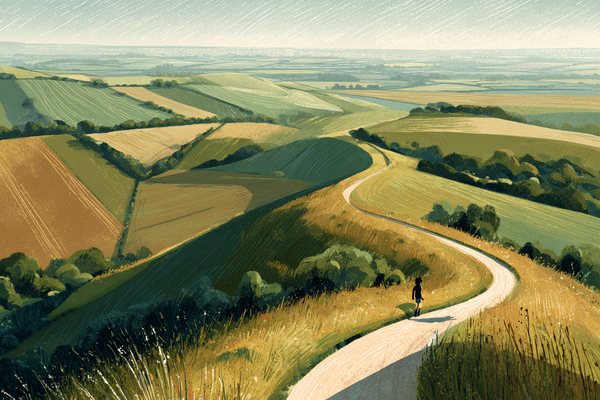
The South Downs Way follows a chalk ridge for most of its length, and the thing that Sarah keeps coming back to is the feeling on the top of it. Two hundred metres up, the ridge snaking ahead, sea on one side, weald on the other. She uses the word soaring. It is, she says, exactly the right word.

The trail is not just open downland. There are sections of dense beech woodland with birdsong layered through it, hedgerows thick with hawthorn and bramble and a variety of fruit that sent them reaching for a bird identification app. There are carefully managed wildlife trust areas where scrub has been left to grow and the birds have responded. And then the ridge again, and the views, and the slow coastal landmarks ticking past — the Isle of Wight at the start, the Spinnaker Tower at Portsmouth, Bosham Harbour, Chichester — a hundred miles of England marked off against the horizon.
The catering, they tell me, divides neatly into two halves. The early days, west of Brighton, offer almost nothing on the trail itself. You carry what you need. Then, as the trail heads east and the day-tripper traffic picks up, the horse boxes appear: artisan toasties, homemade ice cream, every kind of coffee. The contrast is significant enough that it feels like two different trails.
They note that a couple of coffees and a flapjack at one of these stops runs to twelve pounds, but that this is a choice rather than a necessity. They came prepared - they had snacks.

Their packing has been refined considerably since the first trail they did together. Ros has not yet cut her toothbrush in half — a hiking benchmark she hasn't quite reached — but she writes down what she actually used after every trip and edits her pack accordingly. Sarah went to a specialist outdoor shop after a previous trip on which she grabbed the wrong rucksack from the cupboard, got serious backache, and had to offload weight to Ros. At the shop, they let her put different weights in various packs and walk around for an hour. She found one that suited her back and has not had that problem since.
The sock question comes up, as it always does in these conversations, with a level of passion that signifies its importance. Ros is wearing high-wool-content socks with no knotted seam at the toe. Nine hours on the Downs, no blisters. She gave her second pair to her daughter on day six when her daughter's socks started causing trouble.
The Logistics of Six People
Finding accommodation for a group of six, on a trail they're covering at between 18 and 33 kilometres per day, arranged around the available options rather than the ideal distances, is, Ros says, quite hard work. Plenty of B&Bs don't want single-night bookings. The spacing of places that won't add significant extra mileage requires careful planning. There is one youth hostel on the trail but it didn’t sit at the right distance. They found an Airbnb near Seaford that had clearly been set up with walkers in mind — right by the trail, thoughtfully stocked kitchen, comfortable beds, a breakfast they could make themselves and eat at whatever time they needed to leave.
They booked everything themselves, in advance, fitting the accommodation to the stages rather than the other way round. They note that places you expect to be open are sometimes closed, and that self-sufficiency — enough snacks, enough water, not depending on any specific stop — is what keeps a long day from becoming a bad one.
The longest day was 33 kilometres. The shortest was 18. Some days were nine hours on their feet. On those days, Ros says, you just go to bed at the end. There's no social obligation, nothing else on the schedule. You eat, you sleep, you get up and do it again.
· · ·
I ask what they'll take home from the trip. Ros thinks about it.
"On the trail, no one's coming to sort it out," she says. "You've got to get on with it. And I really like that feeling, because it's missing from a lot of the rest of my life."
Sarah talks about the conversations you have walking alongside someone for eight or ten hours — the way long views make certain conversations easier, things you might not say in a room together finding their way out on a chalk ridge. Six family members, three generations, a hundred miles. Precious time, she calls it, which is a phrase that could sound like a platitude but in this context does not.
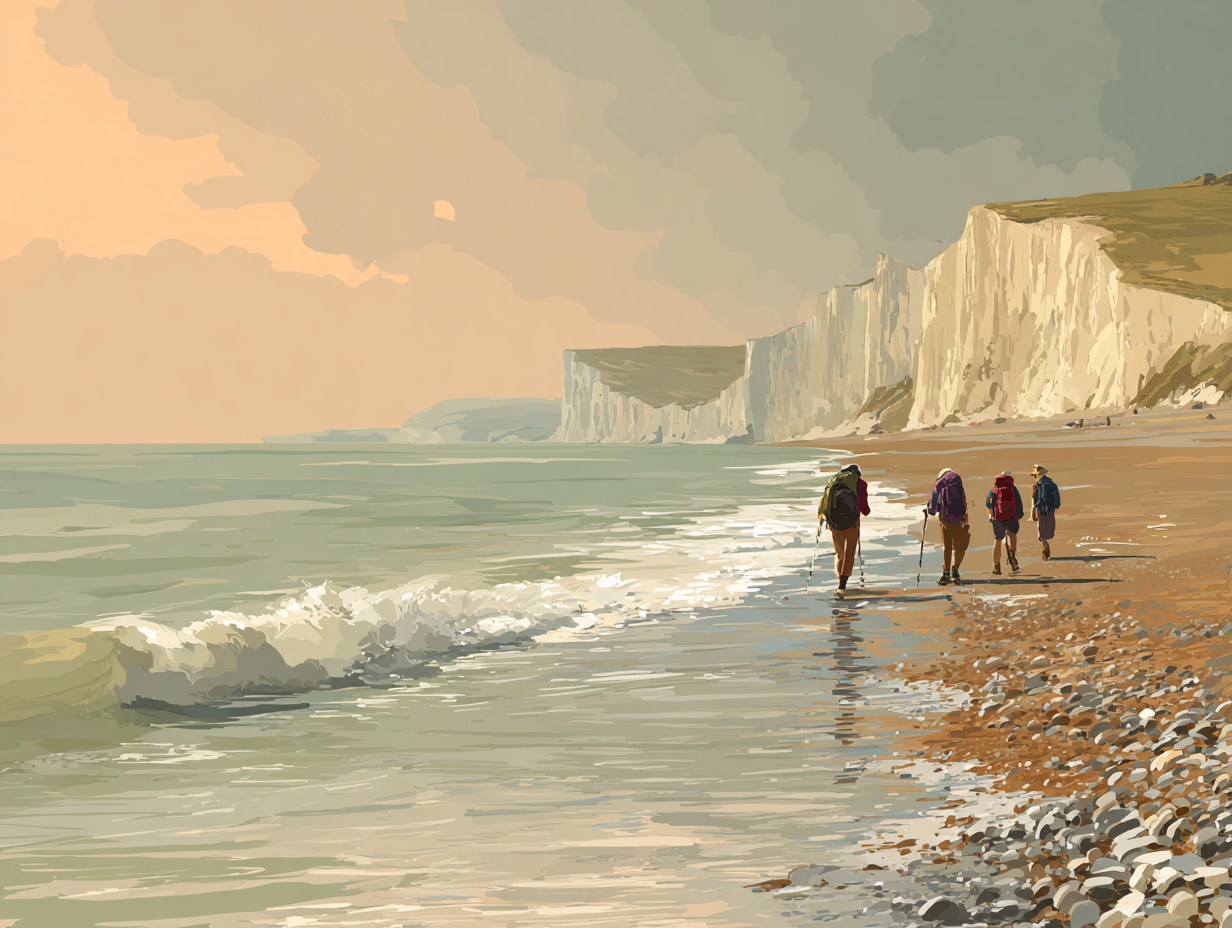
Tomorrow they finish in Eastbourne. They will swim in the sea. They did it in Dover at the end of the North Downs Way too — not the most picturesque swim, Sarah concedes, but it's become the tradition, the way you know it's done.
One more day.