Words by Rob Savin
The plan was concocted in a Wetherspoons at ten o'clock the night before. This should have been the first warning.
Juls Stodel and her friend Richard — a mad Yorkshireman she'd first met in a bothy on Skye, lost, then found again through a postcard she'd left in a shelter in Corrour — had decided to drag a sledge up Cross Fell in the North Pennines. The snow had been falling. They were excited. They bought a nine-pound children's sledge from Go Outdoors, loaded it with food, and a considerable amount of booze, and drove to Hartside Pass.
The snow, it turned out, had not fallen as thickly as they'd hoped. The sledge had no traction. Richard dragged it. Juls walked behind holding it down with her hiking poles to stop it flipping. They crawled against every ditch and burn and ravine the hill had to offer, in mushy snow and thick fog and wetting mistle, and they did not reach Gregg's Hut that night. Or the next night.
"It was incredibly poor planning," Juls says, "for two people that are quite established hill walkers."
They got there on the third night. Two other people walked in two minutes later. Everyone looked at each other in mutual astonishment. Despite it all, they had a fantastic night. The next morning, proper snow had fallen, the sky was blue, and somewhere in the distance a lapwing called.
"It felt like a bit of kismet," she says. "Like we'd had to delay the journey to have that morning on top of Cross Fell."

Juls's journey to that hut — and to the 103 others she visited in the course of this project — began with a landlord's letter and a kind of restlessness she'd been carrying for a while. She'd just finished the Wales Coast Path, all 870 miles of it, over the winter of 2021 to 2022. When she came home, she discovered that her landlord was selling the flat. She looked at the situation and made a decision that most people would think about for considerably longer than she did.
The decision was to put everything in a storage unit in Manchester and set off with a rough plan to spend a night in every open Mountain Bothies Association shelter in Britain. The first entry in her journal read: the only thing you know for sure is that you do not yet know what you don't know.
That was nearly four years ago. She has not been back to the storage unit.
· · ·
What 104 Bothies Looks Like
The MBA lists its open shelters on its website. At the time Juls set off, there were 104 of them, scattered across northern England, Wales, and Scotland — hundreds of miles between some, often inaccessible on foot from the next. A walking route connecting all of them would have been a different kind of project entirely, and Juls knew it. So she planned loosely, in clusters of one to nine bothies at a time, hiking between them and hitching or taking public transport to the next group. After a while, even that vague plan fell away.
"I ended up just making it up as I went along," she says. "And I loved that."
She joined a pair of coast walkers for a stretch. She fell in with someone hiking John O'Groats to Land's End. She followed side quests when they presented themselves and changed direction when the weather or her mood suggested she should. She didn't track miles. She didn't keep data. She left postcards in each bothy with her parents' address on them, and received more than seventy back.
One of those postcards was from Richard, the Yorkshireman from Skye. He then found another of her postcards at Strathan and told the person he was sharing with about the project, and that person knew who she was, and eventually Richard found her on Instagram, and it took them several more weeks to work out they'd already met.
"Something in me said, when I left him at the Lookout Bothy, you're going to meet this man again," she says. "And I'm not one for feelings or signs."
I ask what a bothy night actually feels like, for someone who has never been. She thinks about it properly.
"An average bothy night is pretty chill," she says. "You already have something in common with whoever's there, because you've both come out to this place in the middle of nowhere. In many ways it's camping but under a roof. And then in the morning, after sharing all these memories with a stranger, you part ways and you never see each other again."
She pauses. "I quite like that aspect of it."
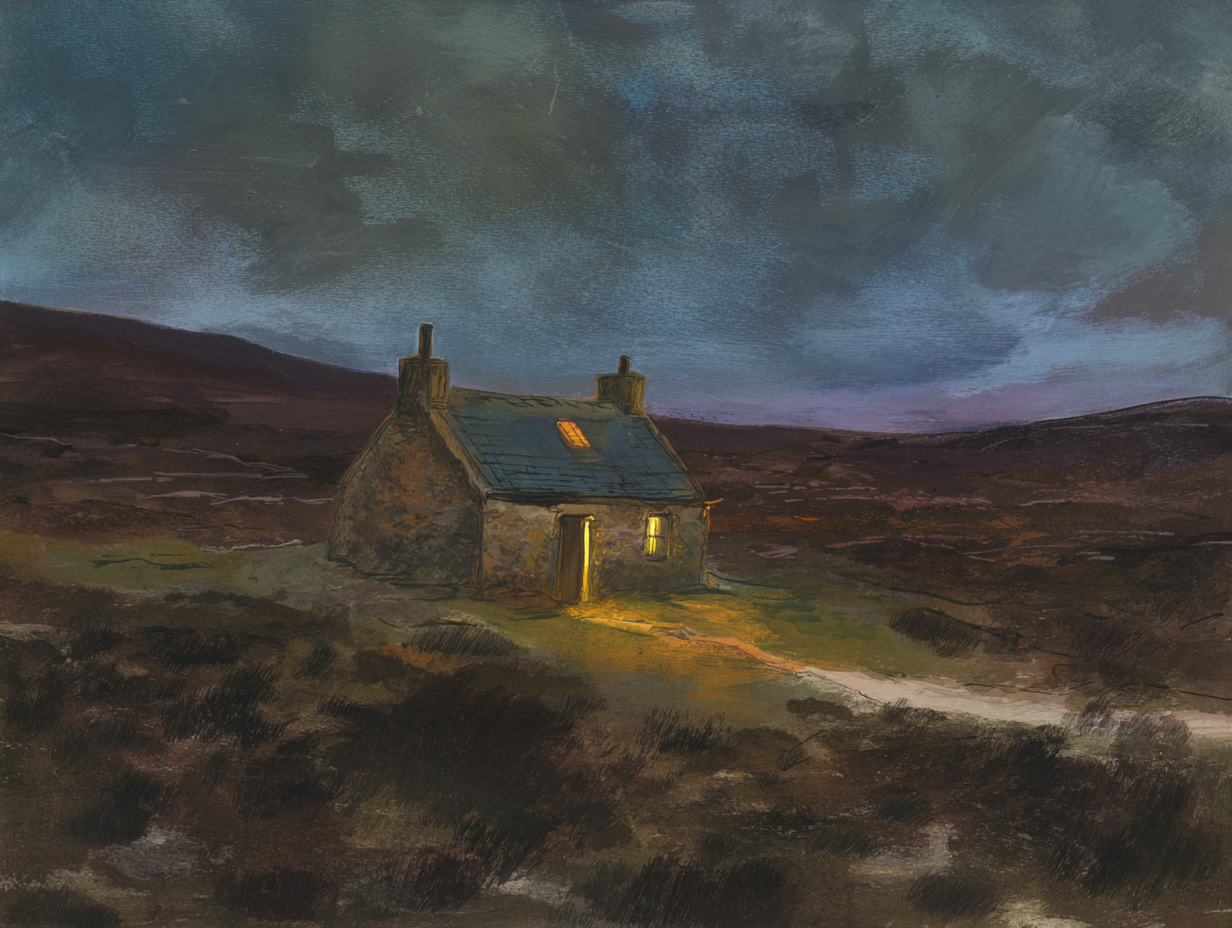
"When your head torch lights up the gable end, it's one of the most reassuring and wonderful feelings you could ever repeatedly have."
· · ·
What Bothies Are
The Mountain Bothies Association is a Scottish charity run entirely by volunteers. It maintains 105 open shelters. You do not book. You may have to share. You do not pay — though Juls is careful about that last point. You pay with the Bothy Code: five rules covering respect for the building, other users, the environment, the estate whose land it sits on, and a cap of six on group size. The rules are, as she puts it, generally common sense when you think about it.
The thing people most often get wrong, she says, is litter. Not graffiti, which was the bigger problem in the 1980s and 90s. Litter. Food left behind with good intentions, gas canisters, tinned goods that no one passing through any longer needs because the culture of bothy-to-bothy travel has changed. All of it has to be carried out by maintenance volunteers, some of whom are making six-mile return trips over bogs to reach their shelter. The MBA recently helicoptered materials in to Strathchailleach on the northwest coast before a work party, then made multiple foot trips carrying tools.
"I always believe in not attributing to malice what can be attributed to ignorance," Juls says. But she would love people to arrive knowing.
What she loves about the bothies, beyond their immediate practical purpose, is their history. These are not purpose-built shelters. They are former croft houses, schools, valve houses, Victorian lodges, servants' quarters, byres, farmhouses — buildings in which people lived full lives in places that are now considered wilderness. Some were still homes in the 1950s. Some families are still in contact about them.
"It's a connection of the history and the landscape and history within the landscape and our place in it all," she says. "That is something I find incredibly magical."
· · ·
The Harder Conversation
There's a moment in our conversation where the register shifts. Juls mentions, without preamble, that she has schizophrenia, and spent years in and out of hospitals. She says it the way someone says something they've explained many times before and decided to be straightforward about.
Her father, during one of the harder periods, told her to stop trying to follow the rites of passage she felt obligated to pursue. Find the thing you love. Just do it. She didn't hear it properly at the time. Later, she understood what he was actually saying underneath it.
"He was screaming: stay with me. Just find a way. Just live. I don't care how."
She's careful about the word transformative. She doesn't think the transformation happens during the big experiences. She thinks it happens in the ugly days before — the moment the brain clicks and decides it needs a life that means something. What the journey does, after that, is confirm it.
"It didn't make me better," she says. "It wasn't the thing that gave me stability in myself. But it was the thing that made me both believe in me and then truly know my limits."
She's equally careful about the word solo. She did all of this alone, technically. But she's quick to say she was never alone: the friends she made in those bothies, her parents, Richard and his catastrophically underpowered sledge. "No man is an island," she says, "and we are products of our archipelago."
I find that a better description than most of the things people say on this subject.
· · ·
If she could go back to any bothy tonight, it would be Gearadail, on the island of Rùm, on the northwest corner looking over towards Canna. A charismatic small hill called Bloodstone Hill beside it. The exterior landscaped by the MBA with bones and stones from the sea.
She finished the bothy project in September 2023. Since then, one shelter has been lost and two have opened. The journey she made cannot be precisely repeated. There is no record to chase, no fixed list to complete.
"I like the fact that no one can have a record or a first or a fastest for this," she says. "It's free from those sorts of approaches."
She is currently working through Scotland's islands — 76 visited, so far. The storage unit in Manchester remains unopened. The only thing she can see in her mind when she thinks of it is a painting a friend made her, years ago.
Everything else, she says, is just stuff.