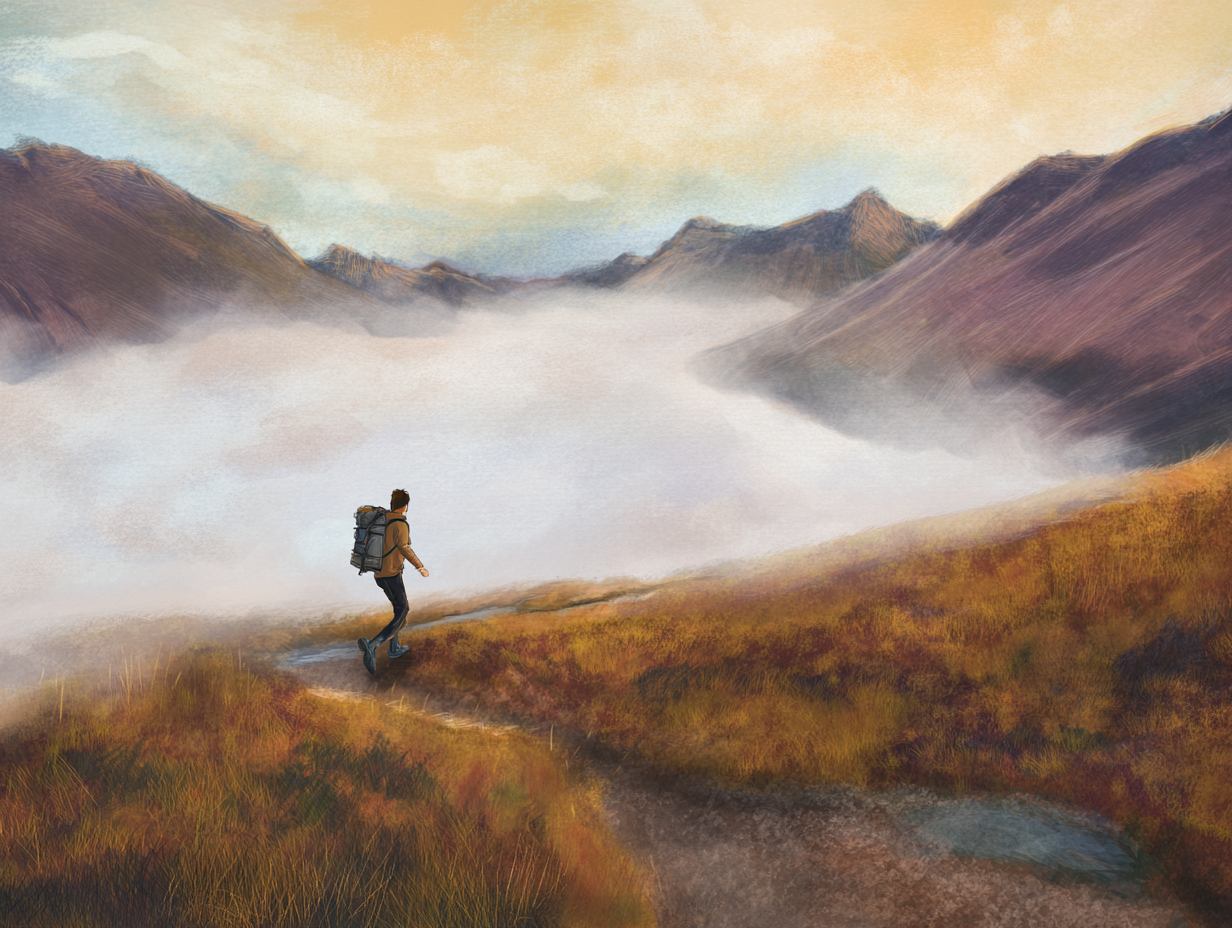
He was somewhere in the middle of a two-hour bog when a Kiwi appeared out of the fog. Coming from the other direction, he was sporting walking poles, an enormous rucksack and the expression of a man having the time of his life. Magnus Ross, meanwhile, was hungry and tired and had wet feet. The Kiwi was going on about the stags. "It's amazing," he kept saying. "The stags are so cool."
Magnus admits he wasn't quite at that point himself. But something about it picked him up. The trail provides, I suggest. He nods. Yeah. Exactly. The trail provides.
He finished the Cape Wrath Trail nine days before we spoke. He looks fine — recovered, clear-eyed, the way people do when they've spent time somewhere properly remote. His legs, he tells me, are still heavier than usual on easy runs. His heart rate is running high for the effort. The body, he says, takes time to come back from something like that, even when your head has already moved on.

The Cape Wrath Trail is not quite a trail. That's the first thing Magnus says when I ask him to describe it. There's no single agreed route, no waymarking to speak of. The general idea is to walk from Fort William to the lighthouse at Cape Wrath. It takes most people around two weeks. Magnus did it in nine days. He covered roughly 350 kilometres.
He spent months planning it at his desk. There was a spreadsheet for gear and another for the daily stages. He sent food parcels sent ahead to a youth hostel and a hotel spaced three days apart, because the shops in the Highland villages — where they exist at all — run to tins of beans and not much else. He gives me the impression of someone for whom this kind of preparation is part of the pleasure.
His longest day was just under 60 kilometres, which took eleven hours. He fell over five or six times a day for most of it, his worn Hoka trail shoes offering almost no grip on wet bog. He'd tried to get them resoled before leaving but it hadn't happened. A good lesson to learn…
Learning to be Alone
For the first three days, Magnus walked with his friend Alex. Then Alex left at Morvich and caught a six-hour bus back to Glasgow — a journey that looks implausible on any map, because the roads up there don't go anywhere in a straight line, but gets you there eventually.
Magnus was apprehensive the night before Alex left. The weather had been bad and they’d been getting blown about on exposed ground. Four more days of that, alone, felt like a different kind of trip entirely.
He woke up to a fog inversion over the loch. The sun was shining and he was out of the hostel door before he even had time to think about it.
The four days that followed were the ones he keeps coming back to. By day three on his own, he'd stopped listening to music. Stopped listening to podcasts. Stopped checking his phone at all, really. He settling into a routine. Waking up, walking, eating, putting the tent up, making food in his JetBoil, and not much else — and found that he was thinking about almost nothing beyond the immediate day.
When a rush of notifications hit him at the end of that stretch — he'd turned his phone on by accident — Magnus felt genuinely resentful. That's the word he uses. Resentful.
When he got home on Saturday, he turned his phone on properly and it all came flooding back. Things to do. People to contact. Something to sort before Monday.
"You realise," he says, "how much stuff is in your mind all the time."
The bothies were new to him. On their first night in one, he and Alex got a fire going, washed in the river and made dinner before bed. When Magnus went outside at two in the morning for a wee, he looked up at the stars and didn't go back inside for a while. It's properly dark up there. He sounds like surprised by this — not something he'd ever really encountered before.

Over the course of the trip, he spent two nights in bothies, two camping, one in a youth hostel, one in a hotel and two more in his dad's camper van. His dad drove the van up to the far north to meet him at the end. Magnus says he was very lucky for that, and he really does sound grateful.
In hindsight, he'd have camped more. Going fast through the stages meant he kept arriving at places with beds, and took them. Someone doing it slower, one stage per day rather than two, would have had no choice but to camp most nights. He thinks that version might be closer to the thing people mean when they talk about the Cape Wrath Trail - the remoteness, the solitude, very few amenities.
What Makes It Worth It
There are three bogs he remembers specifically. One, near Maol Bhuidhe Bothy, involved 45 minutes of sticky, pathless uphill. Another, just after Inverlael, took him off-path for two hours. Then one between Kylestrome and Rekonich, which he navigated in the rain for an hour and a half, the ground already saturated. He tells me this calmly - frustrating at the time, but simply part of the story now.
But then he describes dropping down off a long stretch of heather into a sheltered river gorge — waterfall, green and growing things, the sense of having walked into somewhere protected — and his voice changes slightly. It was like an oasis, he says. And that's the thing, he tells me, that’s what the whole trail is. It’s about contrast between what's hard and what comes after. The bog and then the view. The flies and then the golden eagles.

The golden eagles really stand out for Magus. He saw two of them — a pair, on a perch first, then suddenly in the air and unmistakably massive. He saw a dolphin fin in a loch too, pointed out by Dutch tourists who'd pulled over in a car park. He heard a stag roar in the dark from his tent and thought, briefly, that it was a predator. Mainly because a woman on the tiny ferry at the start had warned him someone had been killed by a stag, instilling some kind of fear.
Just six kilometres short of the lighthouse, which marks the end of the trail, the MOD firing range stopped Magnus short. Their schedule had gone up four days before the end of his trip — far too late for him to plan around.
It means that in the end Magnus completed 97-point-something of the Cape Wrath Trail. It doesn’t really matter, he says. Although the fact he mentions it twice suggests that perhaps it does matter a little bit.
He’s been running again since he got back. His legs are heavy, his heart rate high - but at least while he’s running, the notifications stop.