Words by Kirsty Reade
They were sitting on a ferry to La Palma with a pile of food on the table that could have supplied a small basecamp. Wraps, chocolate, cheese — enough for two and a half days on a ridge where any shops, and most signs of human life, would be a long way below them. Someone in the group had been sick on a previous crossing. Someone else had gotten cactus spines stuck in their legs earlier that week, running off-route into a field on the descent into Los Cristianos. Janie Oates drew both incidents in her sketchbook.
She always takes a sketchbook. It started properly on a trip to Austria — a tiny book, a single pen — and now it goes everywhere. Each evening she creates a cartoon of the day. She draws the cactus field, seasick ferry, the four of them on a ridge at 2,000 metres, wrapped in red fleece blankets they'd found in an unmanned refuge, watching the clouds doing something strange over La Palma. She says she draws to make her friends laugh. You get the feeling it's also how she remembers what matters.
· · ·
The idea for this trip started on a beach. The year before the three-island trip, Janie had been on Gran Canaria for the Transgrancanaria race series — four women, each running different events on different days, one hire car and a lot of driving around in support. On the final day, Janie had already done the marathon, her legs were shot, and she was lying on the beach at Los Cristianos watching a ferry cross the water towards Tenerife.
"I'd heard about people taking ferries between the islands," she tells me. "And I just thought — I kind of want to do that. There's something quite romantic about it."
She mentioned it to her friend Lisa on the way home. Lisa said yes immediately. That's the version of events Janie tells, anyway, with the small pleasure of someone who knows she is lucky in her friends.
The Shape of the Plan
The GR131 is a waymarked route across all seven Canary Islands, roughly 500 kilometres, about a month if you're thorough. Janie and her group used it as a starting point and mostly departed from it. On Tenerife, the established route runs through forest in the east of the island, away from the views, and has a long stretch with nowhere to stay. They modified it to take in Pico Viejo and the high volcanic terrain below Teide instead. On La Palma, they swapped camping for an unmanned refuge on the ridge. On La Gomera, they followed their instincts and ended at a beach.
The planning was real work. Ferry times first, because they dictated everything else. There was a shared Google doc with a rough itinerary, a group call, then each of the four took a different island's accommodation and sorted it. The division of labour, she says, made it feel manageable — and meant that once they arrived, someone always knew where they were going.
What didn't get planned was the distance. Janie guesses around 180 kilometres for the week. She isn't certain. She's on Strava but doesn’t concentrate too much on the numbers. What she thinks about is: we want to get from here to there — can we do it in a day?
· · ·
Tenerife was arid and hot and vast in a way she hadn't quite expected. They climbed from Santiago del Teide through the national park, past Pico Viejo, in temperatures that climbed with them. At some point near the crater, a group of tourists mentioned a café at the Parador Hotel further down. It closed at four.
"We absolutely legged it down the hill," she says. "We literally smashed it down to this hotel because we were like — we need ice cream, we need cold drinks."
They made it. Three cold drinks each. Two ice creams. Then another thousand metres of descent to the coast.
La Palma
La Palma is where the story keeps returning. Sarah mentions it in passing, then corrects herself and mentions it again, and eventually just says it outright: "I could honestly talk about La Palma all day. It's just the best place ever."
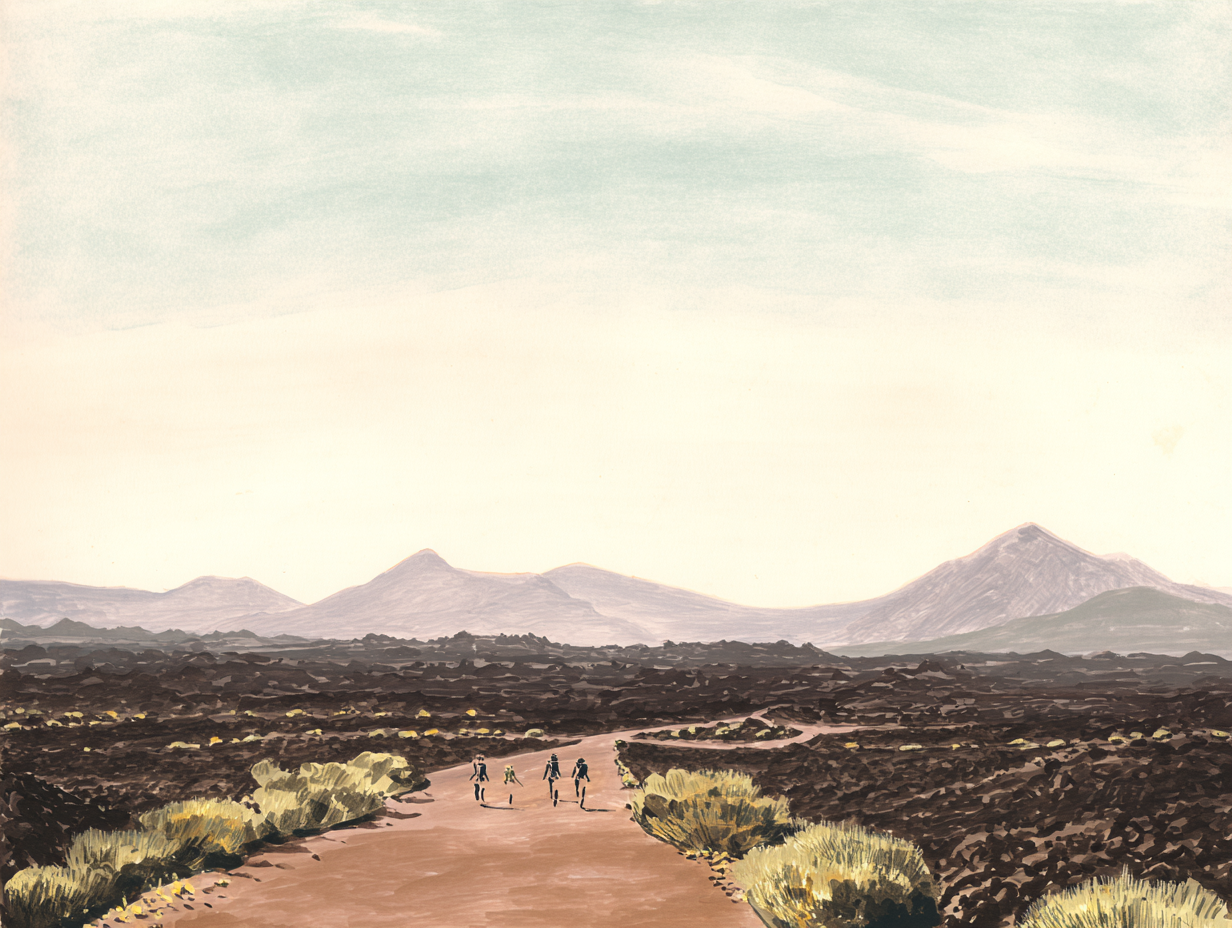
The route climbs to a long ridge around the rim of a huge volcanic crater, then follows the Ruta de los Volcanos south through a landscape of black lava fields and cloud forest. At the top, at the Roque de los Muchachos, there is a tap that could have contained water but, it turned out, didn’t. They only got a couple of hundred millilitres each. Fine. The ridge continued — ten kilometres of up and down above the clouds, with Teide visible as a small triangle on the Tenerife horizon.
Then they dropped into the forest and the weather turned entirely. Cloud and rain and wind, visibility closing in. The trail twisted above cliffs. They were looking for a refuge that seemed not to want to be found. When they finally reached it — a stone building perched on a rocky outcrop — a couple inside were quietly doing their own thing, and nobody said much.
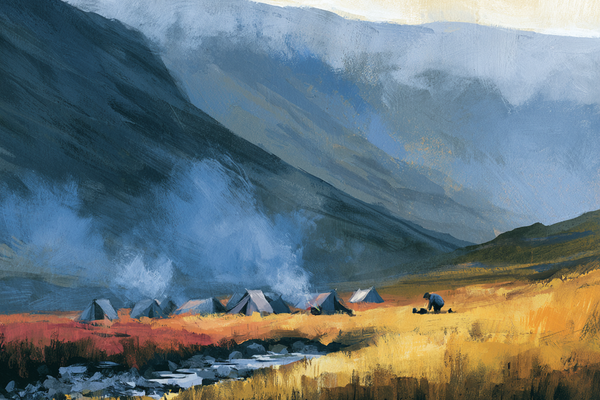
It was cold at 2,000 metres. Colder than you might expect in the Canary Islands. They ate cheese and chocolate and wraps, found the stash of red blankets and went outside to watch the sunset. Lisa said they looked like washerwomen. Later, Janie drew the scene in her sketchbook.

La Gomera was smaller, quieter, stranger. Arriving in the main town felt like pulling into a sleepy outpost. The first day's running took them through cloud forest in low mist, along trails that felt, she says, like they were going somewhere secret. She'd spent time in Costa Rica and Colombia, and the vegetation reminded her of that. "I just felt like I was in a really exotic place," she says. "But I'm in the Canary Islands. I'm four hours from the UK."
On the way out of town, they passed a group of British tourists who wanted to know what they were doing. Running across the islands, they said. The tourists were delighted. One of them shouted after them at the bus stop: "Any one of you, marry our son. Any one will do."

They turned back to the trail and ran into the mist.
Coming Off the Mountain
The final morning they caught the early ferry from La Gomera back to Los Cristianos, and found themselves with four hours to kill before the flight. They put their bags down and lay on the beach. Scruffy running kit, sun, nothing to do. Tourists walking past in both directions. They had just run across three volcanic islands in a week.
"We all agreed that was enough," Janie says. "We would have been bored with any more."
I ask her what the single standout moment is, looking back. She says there are loads, then pauses, then gives the same answer she's been circling all conversation. The ridge on La Palma. The clouds stacking against one side. The crater curving away. The tap at the top with its two hundred millilitres. The blankets. The sunset.
The following year, she and Lisa went back to run the Transvulcania race on La Palma. The year after that, they started planning to run the island's coastline. The full four — Janie, Lisa, Chloe, Despina — are heading back together in February to do just that.