Words by Rob Savin
She looked at the trail going down the hill, and then across at the trail going up the other side, and it did not look encouraging.
"Claire," Marijke said, "I'm not sure I can do this."
She did it anyway, because there wasn't really another option. They went down the cliff path to the lake, and then back up, and rolled into the hut at quarter past eight that night with the kitchen already closed but their dinner kept warm regardless. It was, she says, really, really nice of them.
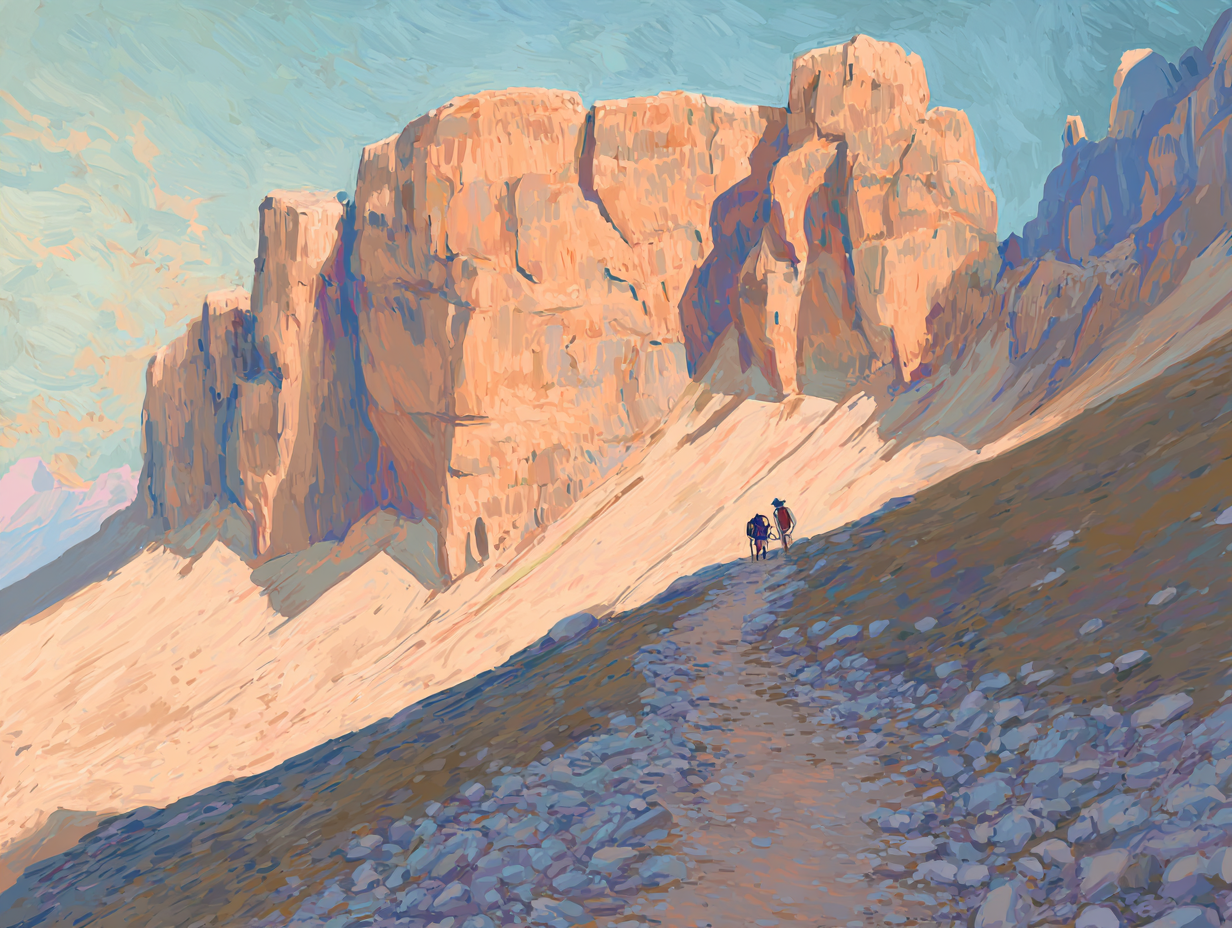
This is the Alta Via 1. 120 kilometres through the limestone peaks of the Dolomites, up and down with very little flat, the edge of the trail falling away steeply on one side and another pass visible on the horizon looking more or less impossible. Marijke had come from Montana. She knows what mountains look like. The Dolomites, she says, were something else entirely.
· · ·
The trip began with an invitation to a wedding she wasn't invited to. Her best friend Claire — who has family in Italy and speaks the language and is, by the account given here, essentially a logistical genius — was going over for the celebrations. Marijke asked if she could come along. Claire pointed out that she couldn't actually attend the wedding, but there was a hike beforehand.
"My partner was like, you've got to go," Marijke says. "Everyone was like, you've got to go."
So she bought a plane ticket. Claire bought the guidebook, called the huts, and assembled six days from a twelve-stage route, working around what was actually available. The Alta Via 1 is one of Europe's most popular long trails, and popular trails book up early. Most people, they discovered on the trail itself, come through a guided company. Claire had done it herself, in Italian, from Washington State, which is a considerable achievement in itself.
The consequence of booking late was long days. Some were over twenty kilometres, with two thousand metres of ascent. On the day they stopped for a leisurely lunch at a mid-route hut, they ended up walking for twelve hours. They didn't make that mistake that again.

The Trail Underfoot
Marijke is used to Montana, where the trails are wide and largely unimpeded and you can, as she puts it, black out and get into the zone and keep going. The Dolomites don't work like that. The surface changes every ten metres — scree to boulders to roots to dirt to scree again — and the exposure is constant. The edge is always there. You have to look at every step.
"I had to focus every single second," she says.
She found, somewhere in the middle of all this focus, that her mind went blank. Not in a bad way. There was simply no room for anything other than the trail in front of her and the mountains around her. She describes it as a relief. There's a lot going on in the world, she says. Being out here, thinking about nothing — that felt like a privilege.
The history is woven into the route as well. The Alta Via 1 passes through several First World War sites where Austria and Italy met in the mountains, and she and Claire spent time thinking about what it would have taken to carry heavy equipment up these slopes with a different purpose entirely. A different experience entirely.
"I'm privileged to have had the opportunity to just think about nothing. Which is kind of like a relief, because there's so much going on in the world."
The days had a rhythm to them once they'd worked it out. Breakfast at seven, out by half past, walk until the terrain or Claire's jokes demanded a stop. They passed huts at lunchtime — the temptation was a beer and pasta, which cost them the twelve-hour day — and learned to grab a sandwich and keep moving. Into the hut around half six, shower, dinner at seven. After dinner, horizontal.
At night, Marijke lay awake, because she's eight hours behind northern Italy and her body didn't catch up for the whole trip. She wore earplugs. She looked at her Kindle. She waited for morning.
· · ·
What Was in the Bag
Marijke’s boyfriend went through her pack before she left and made her take things out. She is grateful for this. The power bank she kept was unnecessary — every hut had electricity (unusual, in my experience, if you’re planning your own trip). The journal she'd planned to bring was left at home, which was the right call; there was no time and no energy and probably nothing left in her head by evening anyway.
What she was glad of: the extra clothes to change into at the huts, which mattered a great deal on a trip this warm and this sweaty. The raincoat and the gloves and the hat, which she didn't use and brought anyway, because in the mountains you always bring them. The two and a half litres of water she carried throughout, more than strictly necessary given how often the route passes a hut, but she's seen enough dehydration to be inflexible on this point. The water filter for the gaps.
What she'd tell someone planning to do it: book the huts in May, as soon as they open. Book stages closer together unless you're confident in long days. Give yourself a couple of days in Italy first, just to adjust to the time change, before you start walking. Don't overpack.
"Claire, book the huts in May," she says, partly to me, partly to Claire across the time zones.
· · ·
The Meadow on Day Three
I ask where she'd want to go back to, if she could.
Not the exposed scrambles with the loose footing and the steep drop. She has photographs of those, and the photographs are enough. What she wants is the third day — past the Lagazuoi hut, down through the busy section, up the steep path on the other side, and then out into a long meandering meadow that reminded her of somewhere in the American West. She and Claire stopped there and put their feet up and had a sandwich.
"Bring me back to that," she says.
She cut the trip fifteen kilometres short at the end, she and Claire, because of rain forecast on some upcoming high and exposed sections. This seemed like a reasonable decision, but means there's unfinished business there. There are also some dinosaur fossil sites she read about afterwards and would like to see. She'll go back.
She's already looking at the photos - dreaming, planning.