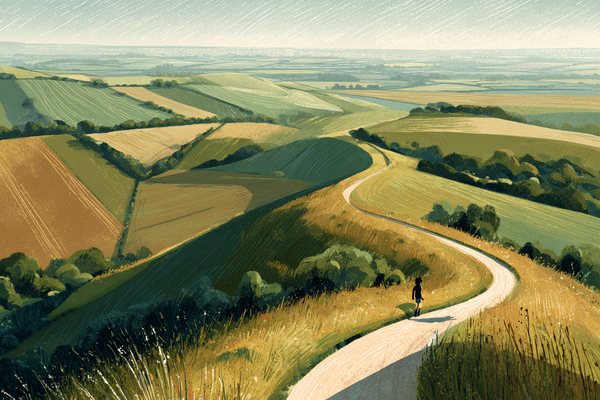
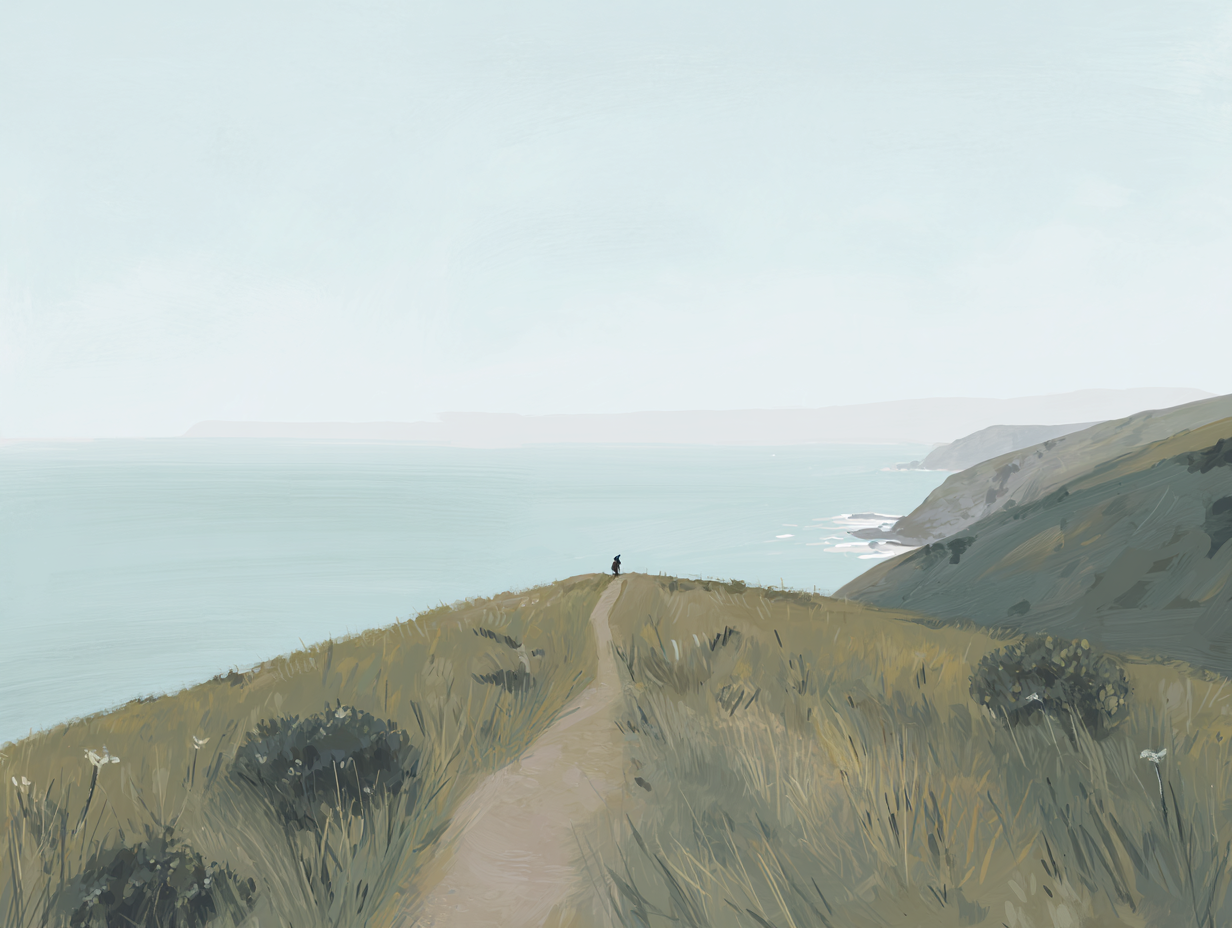
There's a bridge on the edge of Dartmoor. Rickety, small, a stream running underneath. It sits on a section of trail out of South Brent that Claire had never walked despite living just down the road from it for years. She found it the week before the South Hams Way officially launched, on one of those pre-opening reconnaissance walks where everything still feels like it belongs to you. She told me about it almost in passing — the bridge, the stream, the slight disbelief — and then said the line that I think is the whole point of this trail in miniature: who knew it was there?
She did not mean it rhetorically.

The South Hams Way launched in October 2025. A hundred miles, circular, broken into ten sections, linking the South West Coast Path, Dartmoor and a series of small Devon towns that the usual tourist infrastructure tends to pass over. It is about as new as a long-distance trail gets. The waymarking is fresh. The website still has the shine of something recently built. Most walkers in this country haven't heard of it yet.
Claire lives on the route. She's been walking these hills and this coast for years, knows the South West Coast Path the way you know a commute — the views so familiar. And then a new trail comes through, takes a slightly different line across ground she thought she knew, and suddenly she's standing on a path she's never been on, half a mile from her house, with a stream running under a bridge she'd have sworn didn't exist.
I mention the lockdown effect - that particular phenomenon of discovering, within walking distance of home, places you'd somehow never found in years of living there. She recognises it immediately. Yeah, this is it exactly, she says.

The trail divides roughly into two landscapes. Fifty miles follow the South West Coast Path — cliff edges, beach accesses, the grey-green of the English Channel. The other fifty head inland, up onto Dartmoor, where the air is different and the light does something else entirely. Claire is unambiguous about which half she prefers: the coast, through Salcombe, towards Dartmouth, a stretch she knows so well she's almost apologetic about it. I'm biased, she says, because that's where I spend a lot of my time.
But the section that keeps coming back into the conversation is the inland one. The moorland tracks out of South Brent. The bridge. The feeling of not knowing what you're about to walk into on a trail that, technically, you've lived next to the whole time.
I ask her when to do it. Spring, she says, without much hesitation. Longer days, quieter, the moor doing what the moor does in April and May. Or autumn — September and October, when the coast path has thinned out and the seasons are turning visibly over the course of a single week's walking.
There's a rock called Thurlestone Rock. It stands just off a beach on the southern stretch of the coast path — a natural arch, big enough to kayak through at high tide, the kind of thing that makes you wonder how you've never seen a photograph of it. Claire mentions it when I ask if there's a point on the trail she'll always go back to, and the answer expands gently: her husband proposed there. It's a special place for reasons that have nothing to do with the trail.
What strikes me about this conversation is not the trail's scenic credentials — they're there, the coast is the coast — but the particular pleasure Claire takes in the trail's newness. The fact that it exists at all. That someone drew a line on a map, connected things that were already there, and made it possible to walk a hundred miles through a part of England that many people will never visit.
It launched last October. It goes on some of the most famous paths in the UK then turns away, onto trails where hardly anyone is currently going. That, for now, is a large part of the point.