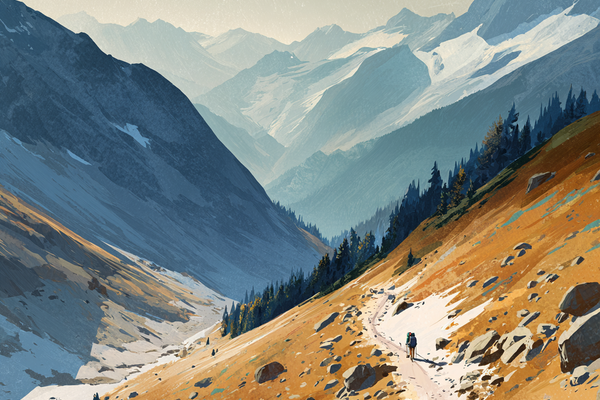
She was lying in her tent in the Richmond Ranges, eating her chocolate.
Not all of it, not yet. But soon it would be gone, and she would have her excuse.
This was day two of what was supposed to be a ten-day crossing of one of the most demanding sections on the Te Araroa — the trail that runs the length of New Zealand, three thousand kilometres top to bottom. Jess Day had been walking it for weeks. She had crossed sand and forest and small towns, sung to seagulls for entertainment, made a trail family. Now she was alone in her tent in the rain, frightened of the mountains in front of her, and she was eating her rations as fast as she could.

"It's almost like I wanted a reason to not be able to carry on," she tells me, months afterwards. "I wanted that excuse to say, no, I need to get out for a day."
She did. The next morning she walked out with another hiker she had met, took two days off in town, ate properly and came back to do the section as a shorter five-day push. She loved it.
There is a particular logic that operates on long trails, where the mind reaches for the most absurd plausible excuse rather than admit it just needs to stop. Jess sees it clearly now.
"I don't know why we do it to ourselves. We just get too caught up in what we think we should do and what everyone else is doing, that we forget what we actually need to do for ourselves."
It might be the most useful thing this whole conversation contains.
The Te Araroa was Jess's thirtieth-birthday trail. She had wanted to do something big and had been searching for months without anything quite fitting. The decision was made by a necklace — a hand-carved Maori fishhook gifted to her, traditionally a symbol of safe travels. She started reading about its origin, found her way to New Zealand, and discovered the trail. The northern terminus is Cape Reinga. Her previous adventure had finished at Cape Wrath. That was enough. "It's almost like destiny to me. I'm going to have to do this trail."
This is also a person who, when asked how she made the leap from a two-week Scottish trail to four-and-a-half months in New Zealand, says: "I'm very good at suddenly deciding upon an idea and just thinking, fuck it."
The actual figure of three thousand kilometres did not land until she sat down with the trail app and started scrolling. She zoomed in to the start. Day one, she thought. Day two. Day three. She kept scrolling. She had barely covered the tip of the map.
"I had a little meltdown and cried about it."
Which is, I would say, an understandable response.
She arrived in Auckland after thirty hours in transit, locked herself in her hostel room, and cried. She had convinced herself she would step off the plane as a confident solo adventurer; she stepped off it as someone who was very tired and very far from home. The next day she got on a bus to the top of the North Island, walked into a hostel filled with other Te Araroa hikers, and was a different person within an hour. Her people. The pressure dissolved.
The weather had other ideas. The morning the trail was meant to begin was so misty she and a small group of hikers could not find the lighthouse at Cape Reinga that marks the start of it. Not the most encouraging opening to a 3,000 kilometre walk. They eventually stumbled upon it, took their photos, and Jess hung back so the others would set off without her. "I thought, this is the kind of journey, you need to start it on your own."

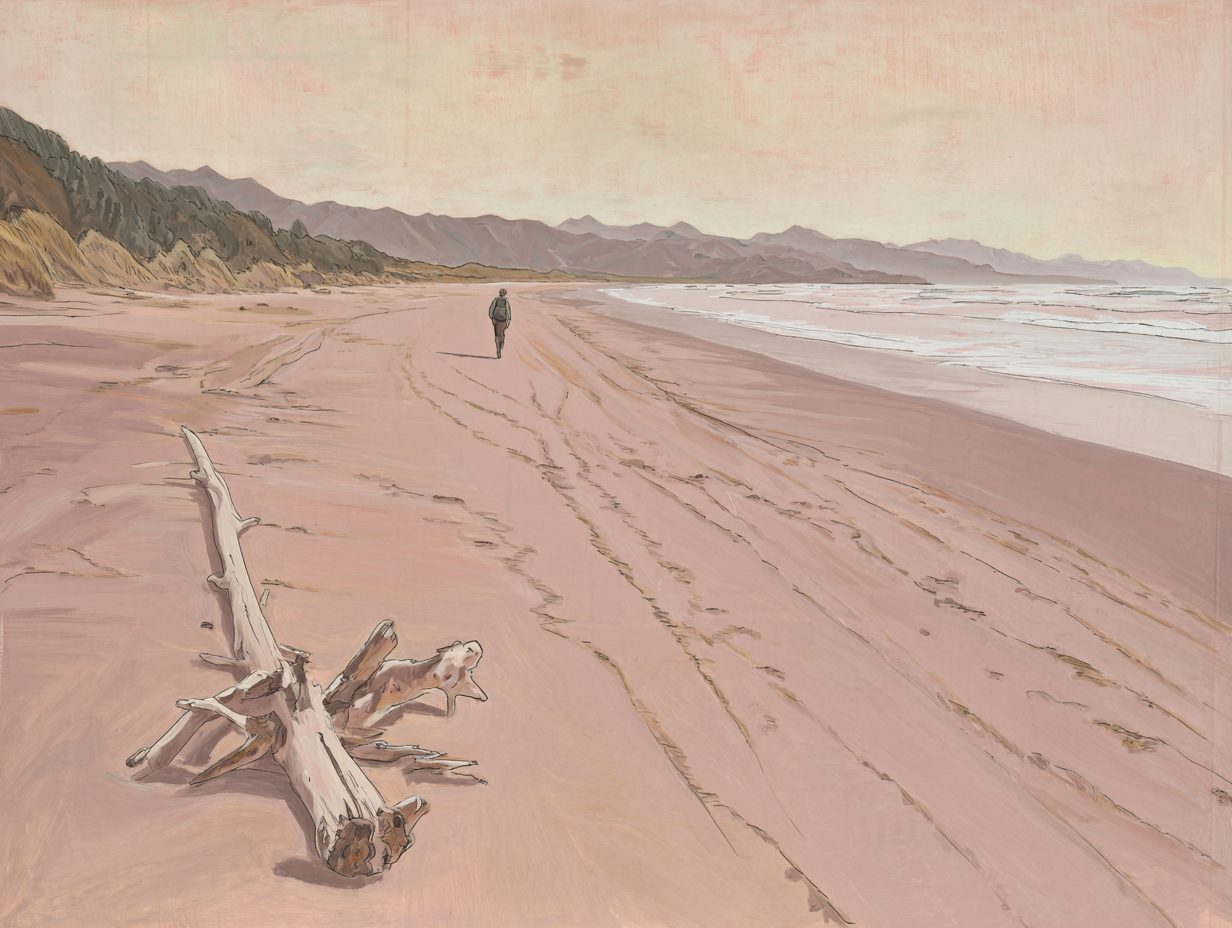
The first five days are on the misleadingly-named Ninety Mile Beach — about fifty miles of sand, sea and sky, in a more or less straight line. Day after day, no scenery change. Jess sang to the seagulls. The hikers entertained themselves by cataloguing the things washed up on the sand.
"You'd all sit around going, what dead things did you see today?"
This is the small, weird, communal pleasure that the brochures will never tell you about, and it is exactly the kind of thing that turns a group of strangers into a trail family within a week. By the time Jess reached the end of the beach, the fifteen people who had camped together that first night were her people. One of them — a girl she met on day one — would still be with her four months later, at the end of the South Island.
Asking Carl
The South Island is a different trail. Bigger mountains, harder weather, more solitude, longer carries. The North Island is community and culture; the South is wilderness. The thing that runs through both, for Jess, is the willingness to ask for help.
Back to the Richmond Ranges, this time after the chocolate. She had restocked, walked the first two days, and arrived at a junction. Carry on up to Mount Rintoul, the highest point of the range, alone in low cloud and rain. Or drop down to a hut and wait.

A hiker called Carl walked past her and stopped for lunch. They talked. She told him she was tired. Then, after a moment, she told him the truth: she was scared.
He had hurt his leg, he said. He would rather have someone to walk with too and they went up Rintoul together.
The next evening, in the hut, Jess looked at the next day's notes — the most challenging section, possibly. The fear came back. Carl was on the top bunk, asleep.
"I just creeped up and like peered over his bunk like, Carl, would you walk with me again tomorrow, please?"
He said yes. They walked together every day for the rest of the South Island. He is now one of her closest friends.
"Everyone's scared, but not everyone admits it when we probably should."
She stays at a campsite reached by a small boat across a stretch of water. The owner, James, has built almost everything on the land himself — cabins, showers, a hiker's shelter. Jess intends to stay one night. She wakes with an infected insect bite on her knuckle, red lines tracing up her arm. James calls a doctor for her, ferries her across, ferries her back. Antibiotics. Then he tells her to stay a few days, in a nicer cabin, in exchange for some weeding.

The next day she gardens in the sun, drinks beer she probably should not be drinking on antibiotics, eats a feast of fresh vegetables from the garden she has just been working in. She is still in touch with him. She has been meaning to send a postcard.
This is the thing trails do that ordinary life is too crowded to allow: a stranger who has no reason to be kind to you, being kind to you, in a way that changes how you feel about everything. Jess has come back determined to keep some of it.
"Maybe this is our responsibility now. We take the trail angel mentality and we take it back into our everyday life."
The final day of the Te Araroa is widely reported to be one of its worst. A long road walk amongst logging trucks, with nowhere safe to step off. Jess and her trail family loved it. They worked out that if you waved at the truck drivers, they would honk. They started rating the honks. They walked to the end of New Zealand laughing at strangers in lorries.

When the trail finishes, it finishes suddenly — a signpost at the bottom of a piece of woodland, no fanfare. People were popping champagne and drinking it out of their hiking boots, which is apparently a thing. Jess politely declined on account of having developed something like trench foot. They went on to a farm down the road run by another trail angel, where almost everyone she had met over four-and-a-half months happened to converge that night. There was, inevitably, a party.
I ask her, at the end, what she would say to someone who has listened to all this and quietly thought: I would like some of that, but I am never going to walk three thousand kilometres.
She is quick to answer. You don't need to. Some of her best adventures have been on the shorter trails she has done in the UK. The lessons are the same lessons. The trail family is the same trail family. The kindness is the same kindness.
Then: "Embrace being a beginner. Learning as you go is the bit where you learn the best kind of lessons. You will learn more about navigation by going and getting lost, and then getting yourself un-lost, than you will by watching a video on it."
I think about this for a while after we stop recording.
The bit I keep returning to is not the mountains or the trail family or even the chocolate. It is the moment of peering over the bunk bed, asking the question. That's the sort of moment you get on the trail, and what is just as available on a five-day walk in Scotland as it is on three thousand kilometres in New Zealand.
The willingness to ask. The permission to stop. And the permission, sometimes, to eat all your chocolate.