Andy Dixon packed crampons. He knew, when pressed, that he probably wouldn't need them — the snow would be soft, it was July, they'd be fine. He packed them anyway. He is generally, he admits, well-prepared. His son Scott uses a more diplomatic phrase: health and safety. Either way, the crampons went in the bag and came back out unused, and they both seem fine with this outcome.
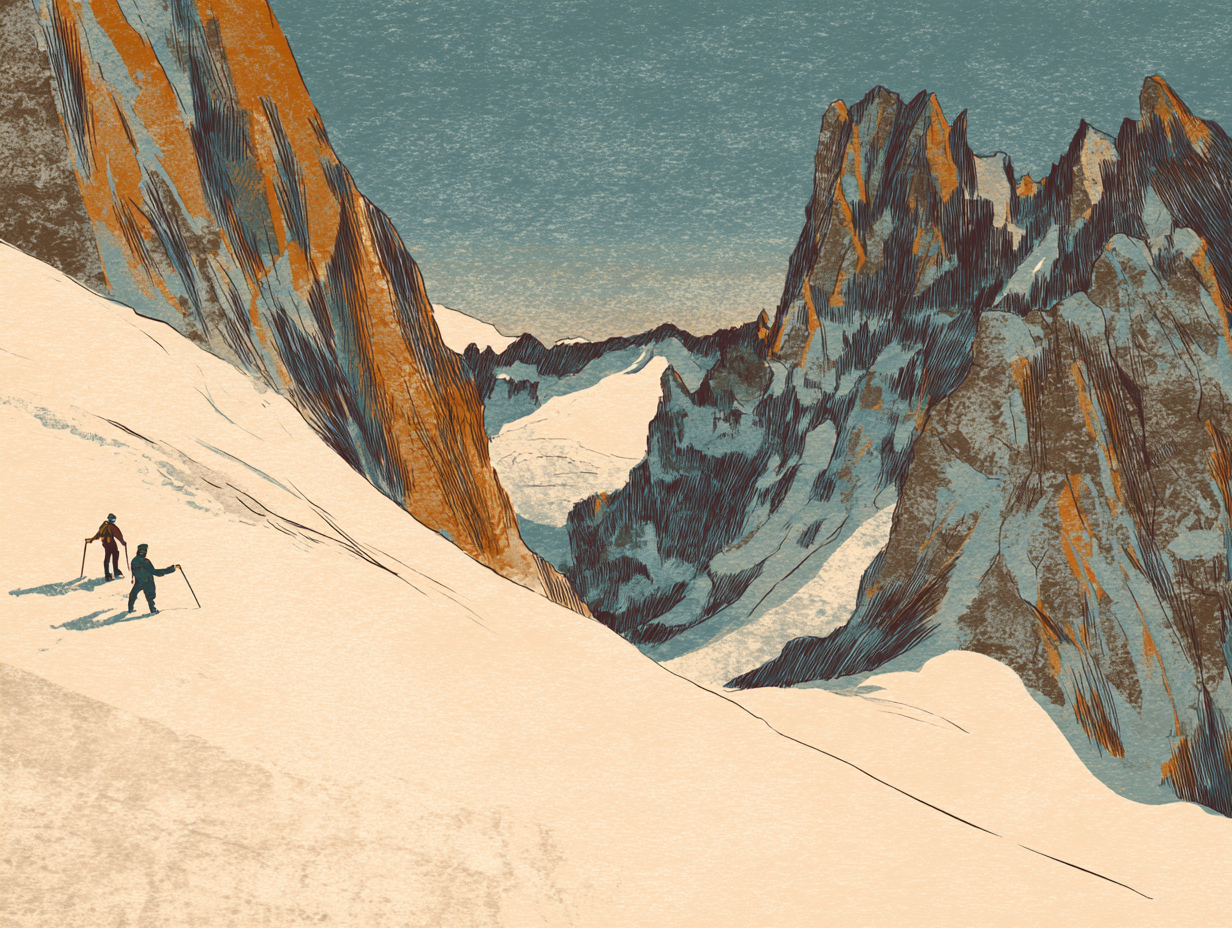
What they did need, on several occasions, were the rubber tips removed from their walking poles — better to get purchase crossing steep snow sections cut across mountain faces at angles that gave, as Andy puts it, a certain sense of vertigo. It's a distinction that matters less in the telling than it did at the time. They were on a path in the Austrian Alps in late June, on their first proper day in the mountains, and the snow was bigger than either of them had expected.
Scott looked at Andy. Andy looked at Scott. This is so cool, they both thought.

The E5 Alpine Crossing runs from Oberstdorf in Bavaria to Merano in northern Italy, crossing Austria the long way. The full walking distance is something in the region of 200 kilometres, though Andy and Scott took a cable car on one section and covered closer to 120 kilometres of actual trail across six days. The route was Scott's idea — he'd done a ski season near Lech and knew the area was close to the E5, and the thought of walking from Germany to Italy through Austria appealed to him in the specific way that clean geographical propositions appeal to certain kinds of walkers. Andy's idea was simpler: he has three adult sons, and he wanted one-on-one time with each of them. Scott chose the itinerary. Andy tried his best to keep up.
They flew into Munich, transferred to Oberstdorf, and on the first morning stood at the edge of a valley in the early sun, cowbells ringing somewhere above them and a set of dramatic peaks visible against a clear sky. There were other walkers setting off around them. There was coffee. There were photographs — Scott at the front, Andy slightly behind. This is the pattern of their photographic record of the trip, which Andy tells me with the dry pleasure of somebody who has made peace with his position.
The Big Day
Day two is the one they both reach for first when asked about the trip, and the one they keep returning to whether asked or not.
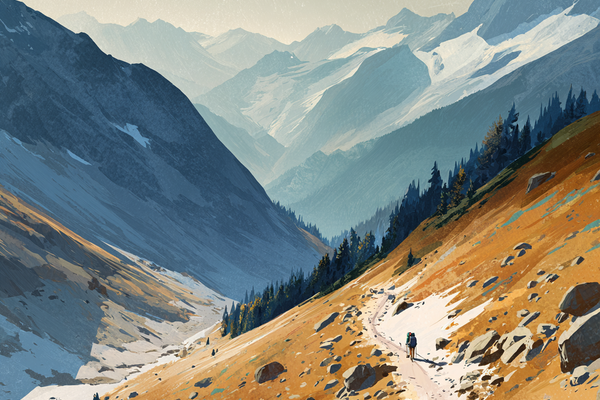
It starts with a steep ascent through trees — unexpectedly lush for the altitude, with horses turned out to pasture at a height that surprised them both. Then the treeline gives way to snow, and the snow goes on for hours. Up to a ridge at around 2,600 metres, between two small jagged peaks that frame the path like a gate, with the Austrian Alps laid out in every direction. Andy has a photograph of Scott straddling that ridge. It's on his wall at home. He describes it in the kind of detail that tells you it gets looked at regularly.
Then down. A long valley descent that goes on for longer than either of them expects — three, three and a half hours — before the valley narrows into the Zammer Loch gorge and the path begins following cliff edges above the river. The town they can see below is further than it looks. Much further, it turns out. They stop for coffee at a mountain hut and assume they must be close to civilisation, because the coffee is inexpensive. Actually, they are still a couple of hours from the bottom.

Andy's feet are killing him by the time they descend into Zams. He feels enormous relief to have arrived. Still, he considers this one of the greatest days he has ever spent walking.
"That day was just utterly outstanding," he says.
"And extraordinarily long," Scott adds.
The remaining four days offer high snowfields, an Austrian ski resort in summer with the piste buried under snowpack and navigated partly by landmark and partly by the quiet pleasure of sliding down sections they couldn't quite follow on foot, and a border crossing into Italy that produces the same uncomplicated satisfaction as the Germany-to-Austria crossing on day one. Three countries. It still feels significant even when you know, rationally, that a border crossing in the mountains is just a sign in the snow.
They stay mostly in valley towns — classic Tyrolean accommodation, proper breakfast, restaurants in the evening. Remote by day, comfortable by night. Andy came prepared for every contingency yet ended up wearing the same shorts for five of the six days. The same as Scott, in the end, who packs light and moves fast. They are reasonably well matched for a week in the mountains, which is either testament to Andy's fitness or Scott's patience, or a mix of both.
The Bella Vista
The refuge they'd been looking forward to since before they left sits high on a rocky plateau near the Austrian-Italian border, used in winter as a base for ice climbing. It is not accessible by cable car. You walk up, in the July heat, with the snowfields providing cold air in waves as you cross them, and horses appearing again in places where horses seem to have no business being.
Andy can't quite remember its name. He says Bella Rosa at one point, corrects himself, and lands somewhere in the vicinity of Bella Vista. The important things he remembers precisely: the altitude, the location, the difficulty of reaching it, and the particular quality of light on an Italian alpine evening at that height when you have earned every metre of the climb.
From the refuge the next morning, the last descent begins. The rocky plateau softens quickly into pasture, and then, before long, there is an emerald lake — glacial green, luminous, unmistakable as a finishing point. They know when they see it that this is where it ends.

"Bittersweet," Scott says. "Knowing it's coming to an end, but knowing you're about to have a great coffee by a beautiful lake in the sunshine, knowing what you've achieved."
They wander down through the undulating terrain above the lake. The coffee, when it arrives, is good. The sunshine cooperates. Somewhere behind them are six days of gorges and snowfields and crampons that never left the bag and a photograph of a son between two jagged peaks with the whole of Austria behind him.
Andy has that photograph on his wall. He mentions it twice.