Every morning, Karen dug the cat hole the night before. This sounds like a minor logistical arrangement and it is, technically. But Ally Beaven describes it as an absolute luxury, and his face, even now, suggests he means it without irony. You get up in the Sierra Nevada at altitude, make your coffee, and then the moment arrives — urgent, non-negotiable — and the hole is already there. Waiting. Someone thought of it for you.
"There's nothing worse," he says, "than flapping and panicking, trying to dig a hole when you think you're about to soil yourself."
This is, he offers, one of his genuine highlights of the John Muir Trail.

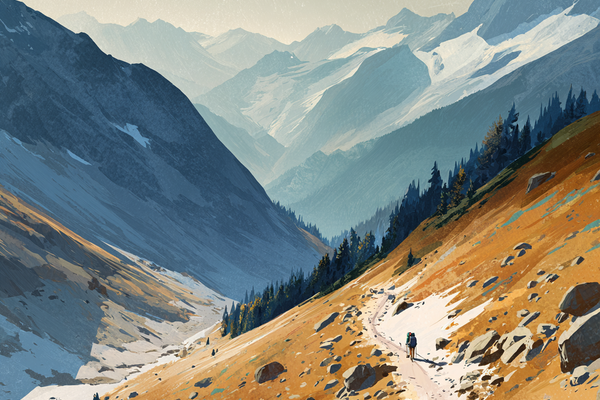
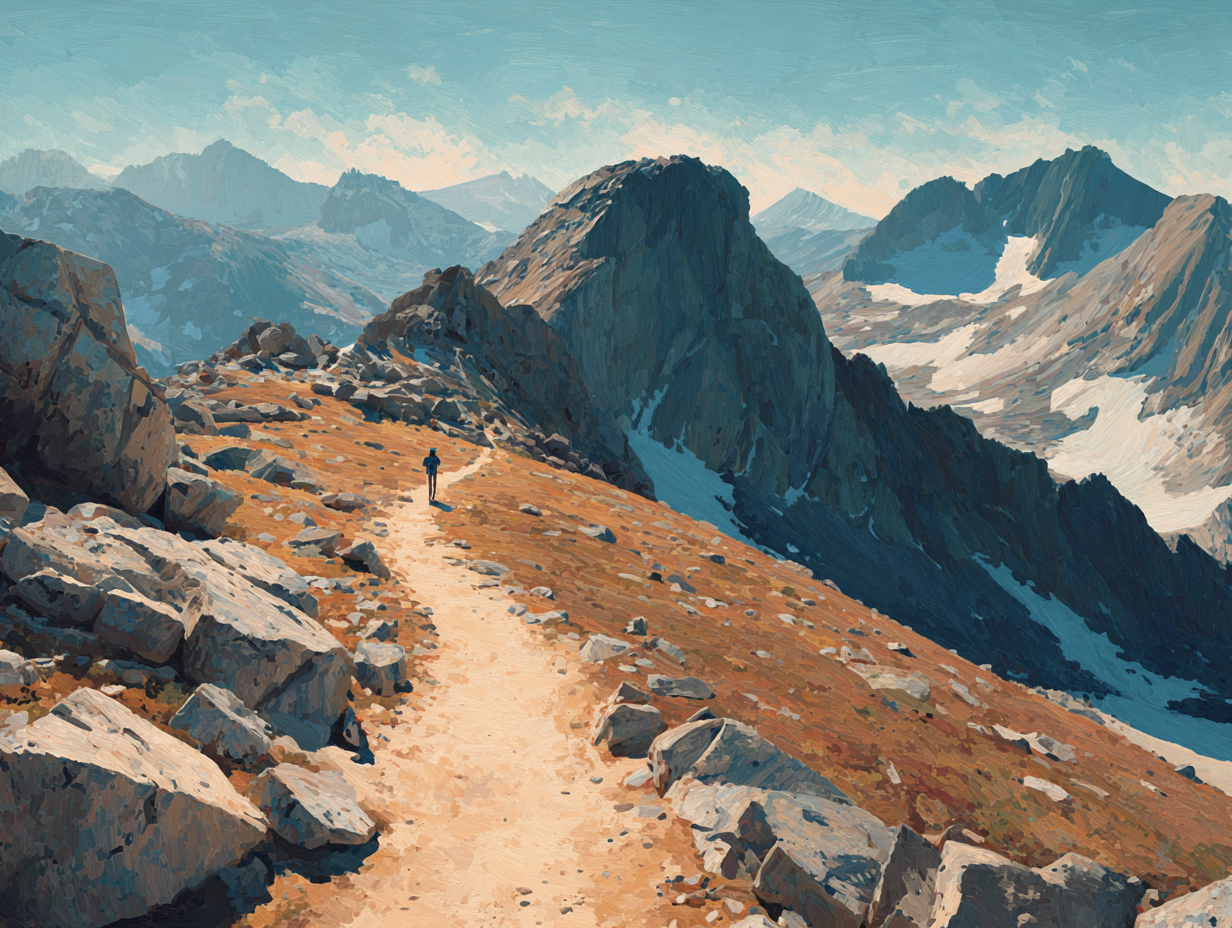
The John Muir Trail runs 340 kilometres from Yosemite Valley in the north to the summit of Mount Whitney in the south, or the other way around if you prefer. You could, if you wanted to, complete it without setting foot on a road or entering a building. You spend very little time below 2,500 metres. At the top of each pass, there is no télésiège, no restaurant, no car park. Just a foot-and-a-half-wide trail wiggling off into the distance, and the reasonable certainty that what you're looking at is more or less what John Muir himself saw when he came through 150 years ago.
Ally had known about it vaguely for years through its overlap with the Pacific Crest Trail, the border-to-border route that sits on many people's lists of things they'll do when they've sorted out the rest of their life. The PCT takes a summer. The JMT took him two weeks. That distinction — the fact that it is feasible without quitting your job — is a big part of what finally made it happen.
He came home from a run one day and told his partner Karen they should go. She agreed. The permit lottery started immediately, and once you have a permit you have a start date and a date means booking flights and booking flights means it is actually happening. He suspects that without the enforced commitment of the permit system, something — a family event, inertia, the usual — would have stopped them.
"My aunt's 27th wedding anniversary," he says, as an example of the kind of thing that stops trips. "So we can't go."
The Logistics of Wilderness
There is, he is candid about this, quite a lot of admin. The Sierra Nevada is not the West Highland Way — you cannot walk into a shop every day or two and restock. There is a place called Muir Trail Ranch, deep in the backcountry, that accepts resupply parcels. The parcels are picked up from a post office box, driven to a lake, put on a boat, transferred to a horse, and delivered to the ranch. To have food waiting for you there, you ship it six weeks before you arrive.
Since they were travelling from the UK, and since customs has a variable attitude to freeze-dried oats, they used a trail outfitter in the States to buy, package, address, and post the resupply on their behalf. This worked. They arrived at Muir Trail Ranch and spent two hours trying to get six nights of food into a bear canister — compressing packaging, letting air out of bags, standing on the lid. Everything that couldn't fit went into the hiker buckets provided for exactly this purpose. Someone pulled out their discarded tortillas and peanut butter almost immediately and was visibly delighted.
They had been on the other side of it too, at Vermillion Valley Resort earlier in the trail, where unneeded resupplies and abandoned gear accumulate from hikers who never made it that far. New shoes. Underwear. Food. Ally mentions this with a kind of affection for the ecosystem of it — the way surplus moves through a trail community, arriving exactly when someone needs it.

The days were roughly 30 kilometres, mostly mellow in gradient by Alpine standards — the JMT tends to follow valley floors upward to the pass at the top, rather than cutting repeatedly across ridges. Ally compares it to Alta Via 1 and 2 in the Aosta Valley: similar distances, twice the climbing. Here the effort accumulates slowly and the passes, when you reach them, feel earned rather than wrested.
They tried to cross each pass by lunchtime because the Sierra Nevada produces afternoon thunderstorms with enough regularity to make this a sensible policy. Camp was chosen partly around this — you don't want to be at 3,500 metres in a boulder field when the weather turns. They slept every night with the tent doors open. Went to bed when it was dark, got up when it was light. Ally says he would live this way for months if he could.
What It Actually Looks Like
People coming south from Yosemite are told, repeatedly, by northbound hikers and PCT veterans and anyone who has spent time in the Sierra: just wait, it gets better. Ally kept not quite believing this, because what was in front of him was already extraordinary — Half Dome and Mount Broderick superimposed in granite behind him from the first sections of trail, the scale of it almost too much to organise into sense.
But the feeling of remoteness does increase as you go south. He looks back at the early days, which at the time blew his mind, and finds them almost tame in retrospect. Too many trees, perhaps. By the high passes in the south, with the Sky Pilot — a purple flower that only grows above 12,000 feet — dotted across the rocky ground, and the lakes below reflecting nothing but stone and sky, he found himself running out of useful language. He describes it as making him incoherent.
The bear arrived on day eleven. He had been quietly worried it wasn't going to happen. A man from Idaho mentioned, in passing, that there was one nearby. They were sitting with their freeze-dried lunch at a suspension bridge when it nosed out of the trees about 60 metres away — close enough to make out its face, far enough not to be a problem. The Idaho man jumped up and ran at it, shouting, banging his poles together. The bear looked at him with what Ally interprets as weary contempt, turned around, and walked slowly back into the woods, looking over its shoulder as it went.
"Gone they are, yeah," Ally says, doing a reasonable impression of the bear's internal monologue.

He had written, before this, about pain — the deliberately sought-after suffering of elite ultra performance. The JMT asked for something different. He had watched enough YouTube footage of people crying in paradise because their feet hurt to be determined that they were not going to be those people. For the most part, they weren't. At one point Karen's shoes felt half a size too small and things became difficult and Ally started quietly checking the maps for exit routes. But then they stopped for lunch and saw the bear. The afternoon was fine.
"It was a pleasure to be savoured," he says, "not a trial to be endured."
The permits took four lottery attempts to obtain. Each lottery covers a week at a time, 24 weeks in advance, and you apply on a Sunday and receive your rejection email on the Monday. When the acceptance came, he describes it as a Willy Wonka golden ticket — the official start at Happy Isles, the full thing, north to south, Yosemite to Whitney. He accepted it by Thursday.
Ally would do the Pacific Crest Trail if he could. He would go back to the Sierra Nevada and do things differently, or the same, or any variation. The bear. The pre-dug cat hole. The tent doors open in the dark. He misses all of it.