Stephen Passmore steps over the lip of a path he hasn't been paying much attention to, and finds himself alongside the Falls of Glomach. The water drops a hundred metres. He is, he says, in "a theatre of noise, of roar, of crescendo." Nature's opera, with Brian Blessed as the lead.
Stephen had read the guidebook and approached them as a thing to navigate. A slippery, narrow path. The day's crux. He hadn't really registered what was on the other side of the lip. Then he was inside it.

This is the rhythm of his trail. He's walking 230 miles north, from Fort William to a lighthouse on the northwest tip of mainland Britain, and he's doing it in 31 days. Most people take two or three weeks. A man called Pavel Cymbalista, who finished the day before Stephen started, did it in three and a half days with 95 minutes of sleep.
Stephen's friend Stu had been into Fort William the morning they were due to set off. He came back with the news as they were finishing a Scottish breakfast.
"I just turned and looked at my pack," Stephen tells me, "which was kind of creaky at the same time."
· · ·
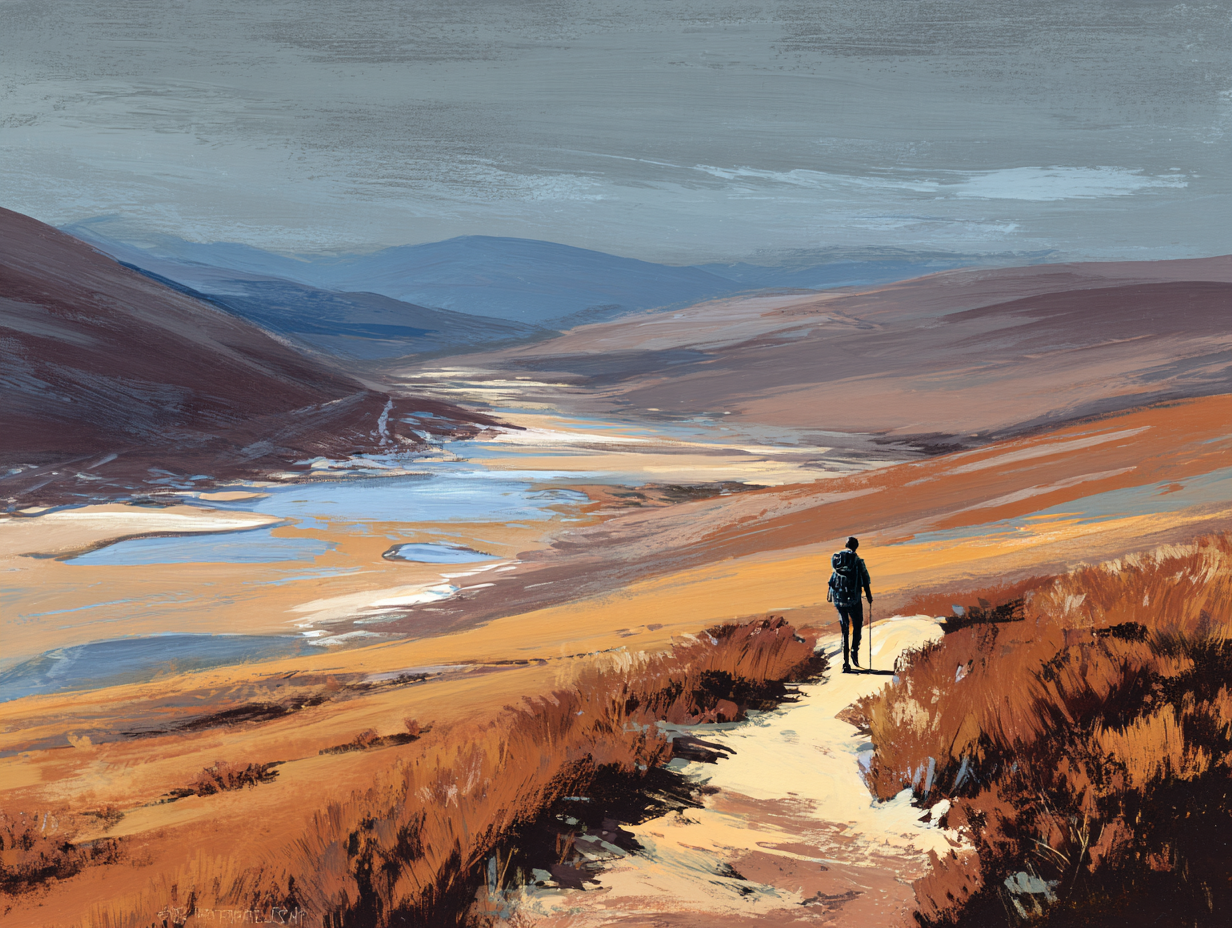
Stephen is an engineer by training. He failed art school. During lockdown he started watching other people share paintings on social media, and noticed they were using them to talk about feelings. He took some adult education classes. By the time he was planning the Cape Wrath Trail, the painting had become three hours a week of complete flow.
So he carried his supplies with him. One paintbrush. Held different ways for thicker or thinner strokes. An A5 watercolour pad with fifty pages. And, for a paint mixer, the plastic tray from a chocolate box. The sort with little compartments for the chocolates. Light. Free. Already full of muddled colour.

The base pack came in around 12 kilos. After a resupply, the food and water took it closer to 22. I asked him how his body held up. The legs got there in two or three days, he said. The trickier thing was the head cold that arrived in the first week.
"Within the first three or four days, I just developed a really hard head cold, and it just all came out."
This is the part most of us recognise. You take time off, you finally start moving the way you've meant to for years, and your body chooses that exact moment to fall over. Stephen's was gone in five days.
· · ·
He had set off in April. By the second week, the cuckoos started.
"I heard a cuckoo, and then the next day, and then the next day. And so basically, it felt like as I was walking north, spring, the season of spring was coming north with me."
He tells me he doesn't remember his feet touching the ground for a while after he registered it. Trees coming into bud. Insects. Birdsong rising. Spring keeping pace.
The toughest day came after a generous one. He'd reached a bothy in the early afternoon to find it closed, but a Mountain Bothy Association working party was there. They were repairing the roof and proudly showing him a sun-trap seat they'd just built on the south wall. They shared coffee. They talked about a heavy rain cell on the way.
Stephen looked across the loch, registered the island feel of the place, and pitched his tent. The first fat raindrops landed as he was zipping it shut. He fell asleep. Woke to the sunset that ended up on the cover of his book. He paid for it the next day with an extra six kilometres over a hill, around the coast, and into peat hags in cloud. By the time he stopped walking, the only ground he could find was tussock. That'll do.
· · ·
Stephen told me a story at the end of our chat, about being in the Cairngorms with his nephews. They were standing in the snow when one of them turned to him and said: it's like we're living in a postcard.
I think about that line a lot. The nephew didn't have the word for what he was looking at, so he reached for the picture of it. It isn't far from what Stephen did on the trail, sitting on a flat rock with a chocolate-box tray and one paintbrush, distilling a day of weather and water and miles into one scene on an A5 pad.

He arrived at Cape Wrath in fog. He couldn't see the lighthouse until he was fifty metres from it. He pitched his tent on the cliffs and watched the beam graze the top of the canvas through the night.
In that moment he wanted one thing. To keep going.