Words by Rob Savin
She found it by feel.
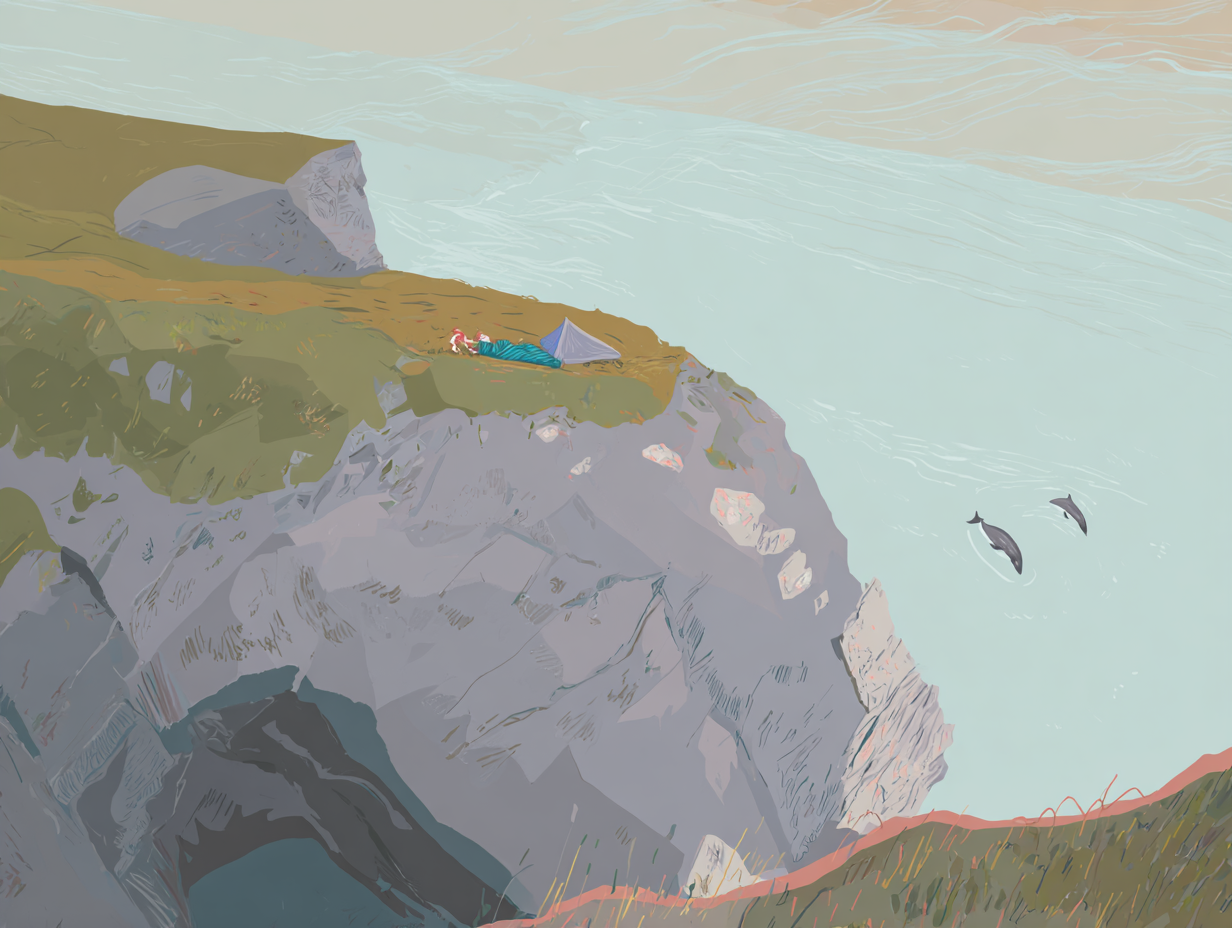
The day had been slower than planned — energy levels were low, the landscape more farmed than she'd hoped, no obvious place to stop. Nicola Whitbread was scanning the edge of the path when she noticed the grass disappearing down into something she couldn't quite see. There was a barbed wire fence. She did a shimmy under it. Not a proud shimmy, just a practical one. On the other side, the land dropped into a series of ledges, each one big enough and sheltered enough, invisible from the path above.
She climbed down and set up her bivvy bag. The sea below was flat and pale, almost milky, merging with the horizon in a way she says she can't quite explain.
Then two dolphins crossed the bay.
"I was like, oh, this was meant to be," she says. "This is wonderful."
· · ·
Nicola is working her way around the entire Wales Coast Path, section by section, on annual leave and long weekends. She does all of it solo and prefers it that way.
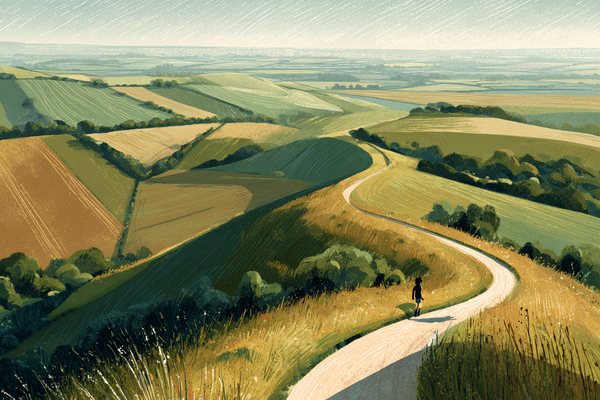
The Anglesey Coast Path is 130 miles, circular, around an island that sits off the north-west corner of Wales, reached by bridge from Bangor. It is not a trail that announces itself. There is no famous peak at the end of it, no celebrated finish line. What it has is varied, persistent, sometimes wild coastline, and a quality of quiet that Nicola describes, with some awareness of how it sounds, as almost magical.
"I don't mean this to sound wishy-washy," she says. "But I genuinely felt it as soon as I stepped foot on it. There's something in the air that's different to anywhere else I've hiked."
She walked it in spring, split across two long weekends, and remembers pretty much every mile.

Travelling Light
Her base weight was 4.3 kilograms. She knows this because she has an app, and she weighs everything, and she finds this genuinely satisfying in a way she's not apologetic about. She has cut her toothbrush in half, saving weight inside her 28-litre pack. She bivvies rather than tents — a sleeping bag inside a waterproof cover, no poles, no pegs, nothing that can't be packed in thirty seconds if the tide comes in closer than expected. Lighter too, of course.
The lightness is partly practical. With 4.3 kilograms on her back, she can go further, stop more freely, scramble down a cliff ledge without the pack making the decision for her. But it's also philosophical, in a way. She's been doing this long enough to have watched her kit list shrink from something unwieldy into something that works, and the process of reduction has its own pleasure.
"I look at my initial load and I think, no wonder my knees were knackered," she says.
She still carries a book and a journal. Luxury items, technically. But leaning her pack against a beach boulder and reading in the afternoons, they seem like a perfectly acceptable use of gram budget.
She also carries trekking poles now, though she didn't need them much on Anglesey. She learned their value on other sections of the Wales Coast Path — the kind where you descend into every cove and climb back out again, all day, until your knees have developed opinions on the matter. "I'm only young," she says, "but trekking poles are the way forward."
"Going light doesn't mean you can't have a couple of luxury items. I had a book and a notebook. If I wanted to rest on a beach, I'd lean on my backpack and get the book out. It was very idyllic."
· · ·
The Island Itself
The Anglesey Coast Path is not a single type of trail. It combines rugged clifftop path and long empty beach and grassy headland and, in one notable section, several miles of inland road walking past an estate that doesn't permit coastal access. Nicola mentions this last part with the mild grievance of someone who has spent days developing a close relationship with the sea and doesn't appreciate being separated from it.
"After so long, coming away from the coast felt almost bereft," she says. "And then when you come back onto the coastline again, it's like: oh, I'm back."
There is Holyhead Mountain — which is only two hundred and something metres but looks down onto cliffs and sea and a lighthouse sitting on its own small island. There is Newborough Forest, sand dunes and pines, the most popular part of the island and deservedly so. There are Neolithic burial chambers and old mine workings and sea-stranded churches you can only reach at low tide. There are caves she stuck her head into out of curiosity. There are, on the long beaches, entire mornings when she didn't see another person.
The wildlife broke up Nicola’s solitude though. Seals, almost every day. Hares. A weasel that came out of a hedgerow on a country lane and stopped dead, staring at her, and then went on its way — she had to Google it afterwards to confirm it was a weasel and not a stoat or a mink, which is the sort of thing you do when you have the afternoon to spare.
And then there was the army.
She was crossing a wide empty beach early one morning, her laundry strapped to the outside of her pack and air-drying as she walked, when she spotted what she thought was a military exercise in the distance. They'd seen her coming for some time — a single dot on a vast beach, moving steadily towards them. She stopped to say hello, because by that point it would have been rude not to.
The officer in charge invited her to join the parachute exercise. She declined. He complimented her on her adventure. She tried to deflect attention from the underwear.
"He said, I can see you've done your laundry," she says.
· · ·
Watching the Tide
The nights become a huge feature in their own right, when you're bivvying.
One evening on a tidal estuary, Nicola checked the tide times before setting up — high tide at eleven, she noted, and stayed awake to watch it. The night was clear and still and the water rose without making any sound at all, creeping across the sand by moonlight, no ripple, nothing. She sat with a cup of hot chocolate and watched it come closer.
It stopped four feet from the end of her sleeping bag.
She watched for another half hour, satisfied herself it had turned, and went to sleep.
"It was lovely just watching the sea inch closer," she says. “Just couldn't hear a thing. Not even a ripple."
There was another night, earlier in the trip, when she'd camped in a cove and misjudged the high tide line even more. She woke in the dark, assessed the situation, made what she describes as a go/no-go decision, deflated her mat, threw the whole thing over her shoulders like a nylon scarf, picked up her bag, and waded back to the main beach. Ankle deep. Fine. She'd been wrong about the tide and she corrected the error and went back to sleep somewhere drier.
This is, Nicola assures me, more amusing than alarming in retrospect. When you're bivvying alone on an island in the dark, your options are limited and your decisions are quick, and she seems to find something genuinely satisfying about that.
· · ·
If she could go back to one moment, she picks an early morning at an abandoned brickworks. She'd stopped for tea. The sunrise came over the old red-brick walls, lit everything orange and gold, and a kayaker hauling his gear up the beach stopped beside her — someone else exploring the island under their own steam, neither of them needing to explain themselves to the other.
They watched it together for a while, and then they both moved on.