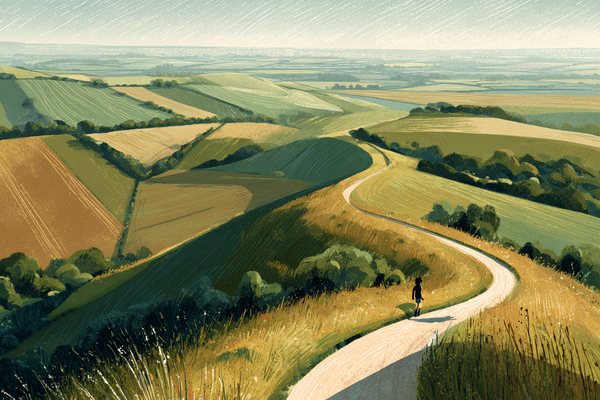
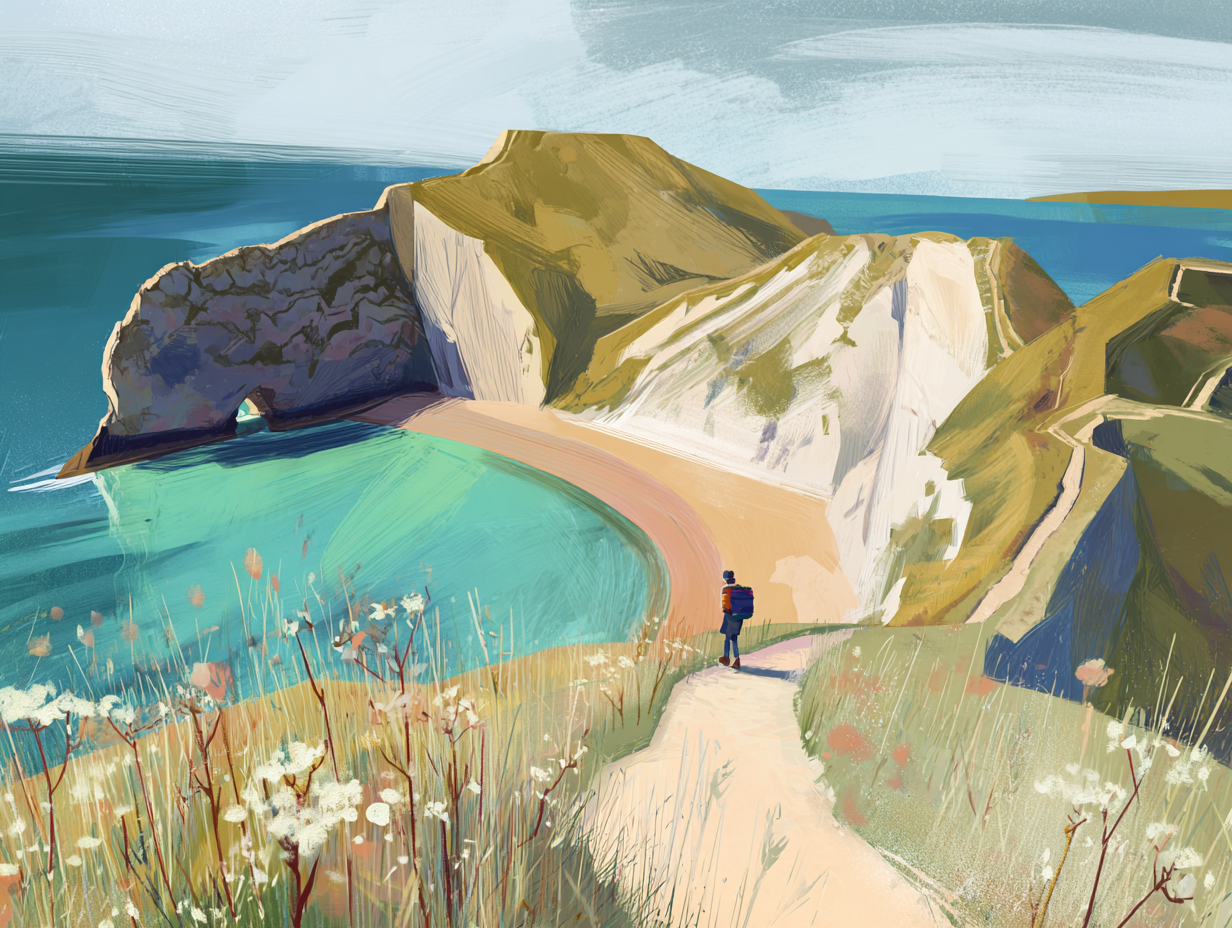
It was about 11am. He was in the middle of nowhere, on a beautiful stretch of the South West Coast Path, with a takeaway cream tea in his bag and a camping stove he'd been waiting for an excuse to use. He put the bag down and got the stove out. He made tea, assembled the scones — clotted cream, jam, some berries he'd been carrying — and sat down to enjoy them in the sunshine.
"The best mid-morning snack you could have hoped for," Morgan De Silva tells me. "Ten out of ten."
He'd been walking for several hours. He still had several more ahead of him. Yet, there was absolutely nowhere he needed to be.
Morgan came to the South West Coast Path the way a lot of people do, though he might not put it in those terms. His business had wound down. His mental health had suffered — anxiety and stress, accumulated in a city where everything is loud and nothing is resolvable by walking. He told himself he needed to get out of London and onto a trail.
He picked the South West Coast Path partly for practical reasons: good train access from London, well-marked, hard to get lost on, towns every day so you don't need to carry much food. And partly because he'd done day sections of it before and knew what to expect. He booked five days for his first section, Bournemouth to Weymouth.
Morgan arrived at the coast in a wind that was sending sand flying horizontally off the beach, and within a couple of miles had hit the cliff line above the Jurassic Coast. From there, it was the most stunning coastline he has ever seen. He includes California in this comparison. His appreciation was enhanced by having studied geology. He knows exactly why the sandstone layers curve the way they do down into the sea.
The Remotest Mile
He tells me something that surprises me a little, and him, even now. The most remote and isolated he has ever felt in the UK was not in the Highlands, not on a Scottish island, not on any of the wilder, less-visited stretches of trail he has covered across the country. It was on the South West Coast Path, somewhere near Sidmouth, on a section of beach about a mile and a half long with a single entry and exit point.

On one side, ocean — hundreds of miles of nothing. On the other, a cliff face fifty metres high that nobody can ascend or descend. Ahead and behind where he stood, a mile or so of empty beach. No exits, no shortcuts. Just him, the sand, the sound of the water.
"That was a surprise," he says. "And a beautiful one at that."
He had not expected this from a trail that people sometimes describe as accessible, well-trodden, safe. He is somewhat evangelical about the word accessible — it gets used, he thinks, as a synonym for easy, which is not quite right. The South West Coast Path is relentlessly undulating. It is not flat. The Jurassic section alone puts in enough climbing to surprise walkers who came expecting a gentle stroll above the sea. It is certainly not easy.
But it is accessible - well signposted, plenty of resources and information out there, dotted with villages and towns, public transport and other amenities, as enjoyable for a short walk as for a long adventure.

His typical day on trail starts at six in the morning, or thereabouts, moving slowly because there are twelve hours of walking ahead and there is no point in burning out before lunch. He carries peanut butter, an apple, a wedge of cheddar that will last three days in a bag if you don't think too hard about it. A spoonful of peanut butter, a bite of apple, a bite of cheddar — he describes this combination with the satisfaction of someone who has refined it over multiple trips. By lunchtime, there is usually a town.
He used to walk to cover distance but something shifted. Now, if he sees something that makes him want to stop, he does just that. He sits on the chalk grassland above Durdle Door. He watches the sandstone shelf at Kimmeridge emerge as the tide drops. He stays with the peregrine falcons above the cliffs until they move on. He has twelve hours and he uses them.
"The one thing I have is time," Morgan says.
The River Erme
If I could put him anywhere on the path right now, he says without hesitation that it’d be the River Erme crossing on the South Devon headland south of Torquay. This section of the trail, he tells me, involves seven or eight river crossings. Most of them have a boat. The Erme does not. You wait for the tide to go out, and then you wade.

He didn't know this when he arrived. He hadn't planned for a tidal foot crossing. He just showed up and the timing was right — low tide, clear water, the fresh river running cold and clean over white sand, the sun out, lunchtime. On the other side was the School House Devon restaurant, which does good food with fresh vegetables and was everything he wanted at that point in a four-day walk. He would go back immediately if he could.
He met two people on that first Bournemouth to Weymouth section who stayed with him. Two lads, slightly younger, looking rougher than the trail warranted. One had been camping in a tent the previous night; the other had decided he'd bivvy out under the stars. A storm had rolled through somewhere up the coast. The bivvy man had ended up outside in it, sleeping bag soaked to nothing, eventually banging on his friend's tent in the rain asking to be let in.
Morgan listened to this with recognition rather than judgement. Nature will win in those situations. The planning and the mitigation are the whole point — not to eliminate discomfort but to make sure that when the storm arrives, you have somewhere to go. Even if that is just a friend’s tent a few feet away.
Another person he recalls is a woman he met on the Torquay to Plymouth section.She’d been walking for seven weeks, using all her annual leave (and then some) on the one trip. Friends from across the UK had been coming out to meet her at intervals along the path. Her story has stayed with Morgan, for whatever reason.
What He Came Back With
Morgan is now documenting his walking on social media — something he resisted for years and came to slowly, after close friends told him they loved seeing what he was doing out there.
Right now, he is preparing for the Pacific Crest Trail, 2,600 miles from the Mexican border to Canada, and plans to document every day of it. Someone whose PCT record he followed closely told him: you won't regret having captured all of it. You can look back on every day and be immediately taken back to where you were.
But before the PCT, there is the South West Coast Path. More sections to walk, more estuary crossings to time, more mornings alone on chalk grassland with a view that he will always stop for now.
He still carries the stove, too, waiting for another takeaway cream tea.