Jennifer sat down in a field of sheep and waited for the sunset. She'd already checked into a shepherd's hut, unpacked, and then walked back out into the evening air with her watercolour kit. The sheep approached her. Not skittishly, the way sheep usually are around strangers, but directly, curiously. Almost as if they'd been expecting her. The sun went down, shades of copper and orange and red. The sheep stood around her in silhouette.
"I don't think I'll ever have something as magical as that on the trail," Jennifer Stevens tells me. "It felt like trail magic."
It was the end of her first day on the Cotswold Way. She had about ninety-five miles still to go.

Jennifer got to the start in Chipping Campden at midday, having taken three trains and two buses from home since, setting off before six in the morning. She was hungry by the time she arrived. She found a café, sat by a window with the old market hall visible outside, and ordered Eggs Florentine. This is how she begins most trails, apparently: by eating a proper meal before the walking starts. It is, as a system, hard to argue with.
She'd chosen the Cotswold Way partly for the villages — the stone buildings, the local pubs, the historic centres — and partly because she knew it was steeped in history and wanted to feel that underfoot rather than just read about it. She'd done enough research beforehand to know roughly what was coming, which turned out to be barely adequate preparation for how it actually felt to be there.
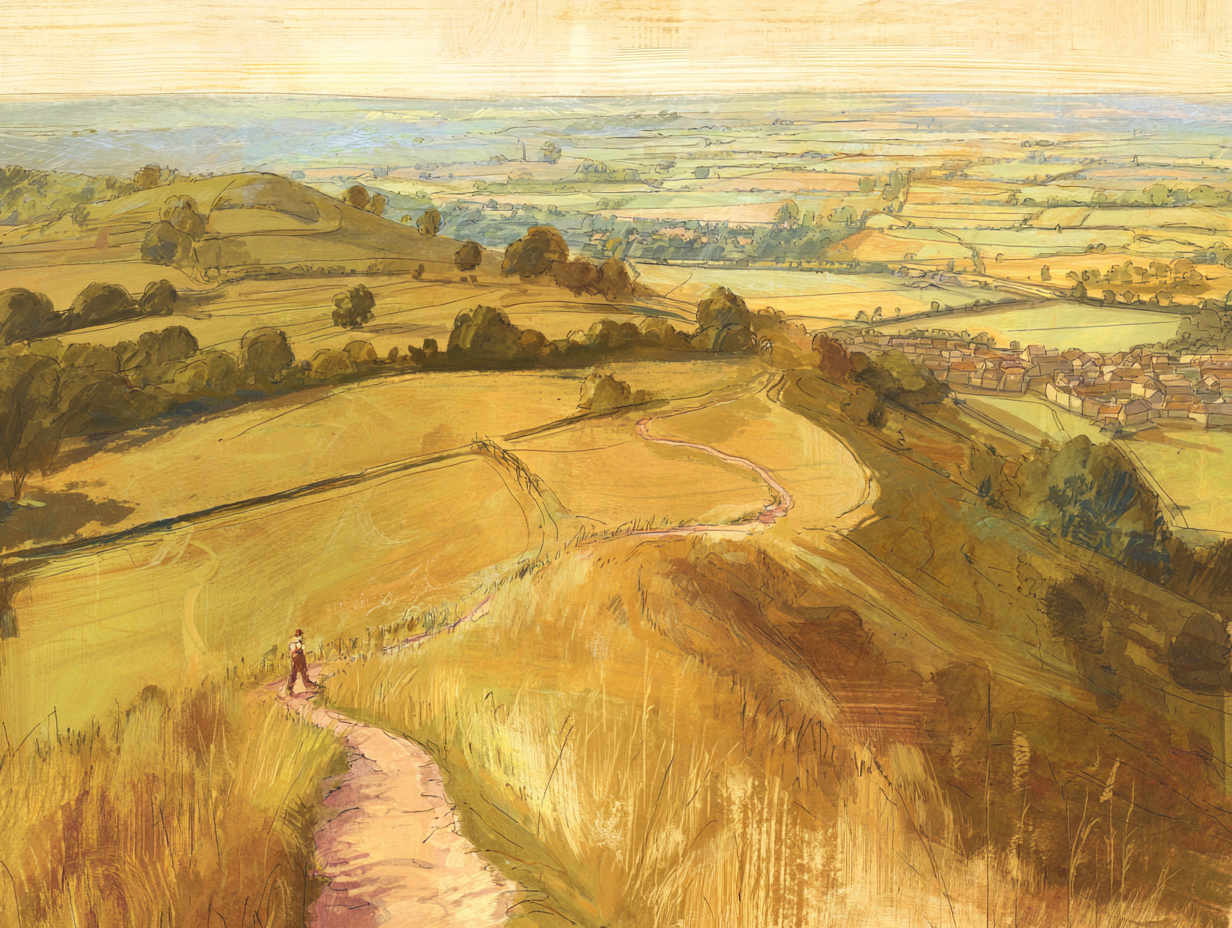
The first hill out of Chipping Campden is Dover's Hill. She'd read about the shin-kicking tournaments held there — an actual tradition in which two competitors hold each other's shoulders and kick each other's shins until one falls down, with straw as the only permitted padding — and had filed it somewhere between charming and alarming. Standing on the hill and looking out at the first viewpoint of the walk, it seemed entirely plausible that this landscape had been producing eccentric traditions for centuries. The information boards confirmed that it had, though.
Tougher Than It Looks
The Cotswold Way carries a certain reputation, and it isn't one of difficulty. Jennifer went in expecting a pleasant amble. She got something much more interesting than that.
"It's very up and down," she says. "And in the heat I walked in, it was tougher than I expected."
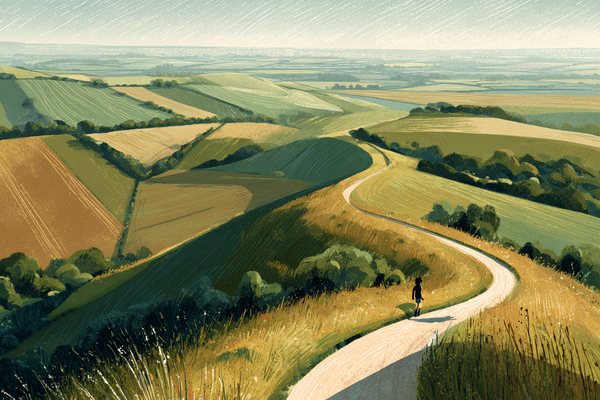
She walked in mid-August, in temperatures that hit 30 degrees on several days. The undulating terrain — never dramatic, never straightforwardly hard, just relentlessly rolling — had a cumulative effect she hadn't anticipated. On the days when the trail ran through beech woodland, the canopy held the temperature down significantly; she had a thermometer in her bag and watched the difference. On the open hilltops, there was no shelter and no shade, and the views were the only recompense. Luckily they were enough.
Jennifer pushes back, gently, on the idea that difficulty is what makes a walk meaningful. An adventure, she argues, doesn't need to be remote or extreme. The Cotswold Way gave her something else — a succession of places that affected her more than she had imagined they would. Crickley Hill, where a plexiglass information board overlays a sketch of an ancient settlement onto the actual landscape behind it, so you see both at once: the hill as it is now, and the roundhouses as they were. Long barrows and excavated sites that made her think, involuntarily, about Indiana Jones. The Arts and Crafts movement in Broadway, which she'd read about and thought she understood, and then walked into and found she hadn't.
"When you imagine how you might feel," she says, "it's very surface level compared to the actual emotions you do feel when you're actually there."

Stanton, on the second day, is the moment she keeps returning to. A village a few miles south of Broadway, quiet enough that she arrived to find nobody there at all. She saw the buildings and stopped walking.
"I actually wanted to cry," she says. "I was thinking, this does not feel real."
She says it lightly, aware it sounds excessive, but not embarrassed by it. This is what she came for — not the information boards or the café stops or even the sunsets, but the occasional moment when a place arrives so completely as itself that it simply undoes you.
How She Planned It
Jennifer usually wild camps. It's her default setting on long trails, and it simplifies the logistics considerably: you walk until you want to stop, and then you stop. The Cotswold Way doesn't really work like that — too many protected areas, too many excavated sites where it would feel disrespectful to pitch a tent, and in August, too few proper campsites that weren't either full or inconveniently placed. So she booked ahead: shepherd's huts, camping pods, a room in someone's house. More planning than she's used to, but it paid off.
The first shepherd's hut, above Broadway, with its stable door opening onto fields of sheep. The camping pod on the third night, where the fog cleared into a beautiful sunset and she ended up talking around a fire pit with a woman and her daughter until late. The last shepherd's hut, in a hamlet called Bech, where she watched deer move through a field as a magenta sun set behind them.
She booked all of these in advance. She did more research than usual — history, villages, what to expect. She arrived knowing more than most walkers do, and still found herself surprised repeatedly.
I ask her what people most underestimate when they're planning a walk like this. She thinks about it. The terrain, yes — harder than it looks. But more than that, she says, you can't really plan for how certain places will make you feel. You can read about Stanton. You can look at photographs of Stanton. None of it prepares you for Stanton.
The food stops deserve their own account. Eggs Florentine in Chipping Campden, by the window, before the walking began. Tapas and locally-made wine in Wotton-under-Edge on day five — aubergine, potatoes, bread, a rustic room that matched the meal. The Dog Inn at Old Sodbury. It’s clear that eating well on trail is not a treat but a baseline expectation for Jennifer, and the Cotswold Way met it consistently.
Day five was, she thinks, her favourite. It was hot — close to 30 degrees — but spent mostly in beech woodland, cool under the canopy, the sun coming through the leaves in long stripes. The thermometer in her bag registered the difference from the open hillside. She watched it climb and fall as the trail moved in and out of the trees. That evening, she arrived in Wotton-under-Edge and had the tapas.

Walking into Bath
The outskirts of Bath were jarring. After a week of villages in honey-coloured stone, moving through history at walking pace, the urban approach to Bath felt like a different medium entirely. She knew Bath — had visited regularly for years before COVID, knew its streets and its scale and its Roman bones — and found the familiarity comforting. Bath is, in some sense, an enlarged version of the Cotswold villages: the same warm stone, the same depth of history, the same feeling of a place that has been carefully built and carefully kept. A scaled-up version of everything she'd walked through.
She still wants to go back. Not just to do the trail again, though she'd do that too, but to take her family through the villages she passed. Stanton. Broadway. The shepherd's hut field at dusk with the sheep standing in silhouette.
Some places you visit. Some places you return to. The Cotswold Way, it turns out, is absolutely the latter.